Eukaryotic RNA Transcription and Processing: Overview of RNA Types and Modifications
180 likes | 341 Vues
This document explores the intricacies of eukaryotic RNA transcription and processing, covering the roles and modifications of rRNA and tRNA. It details transcription by different RNA polymerases (I, II, III) along with their specific promoters and sensitivity to α-amanitin. The nuances of post-transcriptional modifications, mRNA capping, polyadenylation, and splicing mechanisms are elucidated. The document also highlights the importance of introns and exons, the role of spliceosomes, and alternative splicing, which generates protein diversity from a single transcript.


Eukaryotic RNA Transcription and Processing: Overview of RNA Types and Modifications
E N D
Presentation Transcript
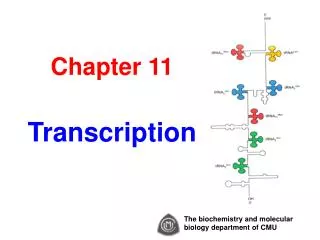
Stable RNA • rRNA -Structural component of ribosomes • tRNA-Adaptors, carry aa to ribosome • Synthesis • Promoter and terminator • Post-transcriptional modification (RNA processing) • Evidence • Both have 5’ monophospates • Both much smaller than primary transcript • tRNA has unusual bases. EX pseudouridine
tRNA and rRNA Processing • Both are excised from large primary transcripts • 1º transcript may contain several tRNA molecules, tRNA and rRNA • rRNAs simply excised from larger transcript • tRNAs modified extensively 5. Base modifications
Examples of Covalent Modification of Nucleotides in tRNA 7-Methylguanylate (m7G) Inosinate (I) N6-Methyladenylate (m6A) N6-Isopentenyladenylate (i6A) Uridylate 5-oxyacetic acid (cmo5U) Dihydrouridylate (D) Pseudouridylate (Ψ) (ribose at C-5) 3-Methylcytidylate (m3C) Modifications are shown in blue. 5-Methylcytidylate (m5C) 2’-O-Methylated nucleotide (Nm)
Eukaryotic Transcription • Regulation very complex • Three different pols • Distinguished by -amanitin sensitivity • Pol I—rRNA, least sensitive • Pol II– mRNA, most sensitive • Pol III– tRNA and 5R RNA moderately sensitive • Each polymerase recognizes a distinct promoter
Eukaryotic Polymerase I Promoters • RNA Polymerase I • Transcribes rRNA • Sequence not well conserved • Two elements • Core element- surrounds the transcription start site (-45 to + 20) • Upstream control element- between -156 and -107 upstream • Spacing affects strength of transcription
Eukaryotic Polymerase II Promoters • Much more complicated • Two parts • Core promoter • Upstream element • Core promoter • TATA box at ~-30 bases • Initiator—on the transcription start site • Downstream element-further downstream • Many natural promoters lack recognizable versions of one or more of these sequences
TATA-less Promoters • Some genes transcribed by RNA pol II lack the TATA box • Two types: • Housekeeping genes ( expressed constitutively). EX Nucleotide synthesis genes • Developmentally regulated genes. EX Homeotic genes that control fruit fly development. • Specialized (luxury) genes that encode cell-type specific proteins usually have a TATA-box
mRNA Processing in Eukaryotes • Primary transcript much larger than finished product • Precursor and partially processed RNA called heterogeneous nuclear RNA (hnRNA) • Processing occurs in nucleus
Capping mRNA • 5’ cap is a reversed guanosine residue so there is a 5’-5’ linkage between the cap and the first sugar in the mRNA. • Guanosine cap is methylated. • First and second nucleosides in mRNA may be methylated BACK
Polyadenylation • Polyadenylation occurs on the 3’ end of virtually all eukaryotic mRNAs. • Occurs after capping • Catalyzed by polyadenylate polymerase • Polyadenylation associated with mRNA half-life • Histones not polyadenylated
Introns and Exons • Introns--Untranslated intervening sequences in mRNA • Exons– Translated sequences • Process-RNA splicing • Heterogeneous nuclear RNA (hnRNA)-Transcript before splicing is complete
Splicing Overview • Occurs in the nucleus • hnRNAs complexed with specific proteins, form a ribonucleoprotein particle (RNP) • Primary transcripts assembled into hnRNP • Splicing occurs on spliceosomes consist of • Small nuclear ribonucleoproteins (SnRNPs) • components of spliceosomes • Contain small nuclear RNA (snRNA) • Many types of snRNA with different functions in the splicing process
Splice Site Recognition • Introns contain invariant 5’-GU and 3’-AG sequences at their borders (GU-AG Rule) • Internal intron sequences are highly variable even between closely related homologous genes. • Alternative splicing allows different proteins from a single original transcript
RNA pol III • Precursors to tRNAs,5SrRNA, other small RNAs • Promoter Type I • Lies completely within the transcribed region • 5SrRNA promoter split into 3 parts • tRNA promoters split into two parts • Polymerase II-like promoters • EX. snRNA • Lack internal promoter • Resembles pol II promoter in both sequence and position
DNAse Footprinting • Use: promoter ID • End Label template strand • Add DNA binding protein • Digest with DNAse I • Remove protein • Separate on gel Protected region