Understanding Key Principles of Natural Rights and Social Contract Theory
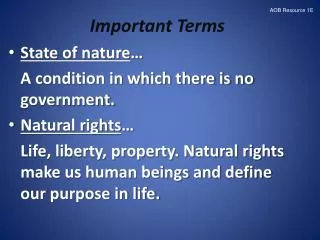
This resource explores fundamental concepts such as the state of nature, natural rights, and the social contract. The state of nature refers to a condition without government, where individuals possess natural rights—life, liberty, and property—defining human existence. The social contract establishes an agreement among individuals to form a government that protects these rights. Additionally, it highlights the right of revolution, emphasizing that people can reclaim their power if the government fails to serve its intended purpose.

Understanding Key Principles of Natural Rights and Social Contract Theory
E N D
Presentation Transcript
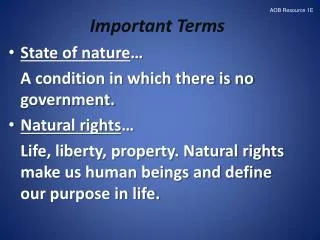
AOB Resource 1E Important Terms • State of nature… A condition in which there is no government. • Natural rights… Life, liberty, property. Natural rights make us human beings and define our purpose in life.
AOB Resource 1E • Social contract … The best way to protect each person’s natural rights so all people can enjoy them and live at peace with one another. Individuals must agree to live with others to create and live under a government and give that government the power to make and enforce laws.
AOB Resource 1E • Right of revolution … Since the people give the power to the government, they have the right to take it away if the government is not serving the purpose for which it was established.