Challenges and Solutions in High-Energy Proton Detection and Gamma Ray Analysis
This work addresses the challenges associated with high-energy gamma rays and proton detection in nuclear reactions. We explore the Doppler-shifted gamma rays and the necessity for high-density, high-resolution techniques for effective detection. With an efficiency of over 60% for add-back detection at 300 MeV, we demonstrate methods to distinguish between signals using advanced ∆E measurement techniques. GEANT4 simulations for proton interactions at 180 MeV help in analyzing total energy losses in various detection systems, leading to improved resolution in both proton and gamma responses.

Challenges and Solutions in High-Energy Proton Detection and Gamma Ray Analysis
E N D
Presentation Transcript
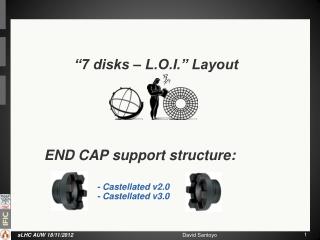
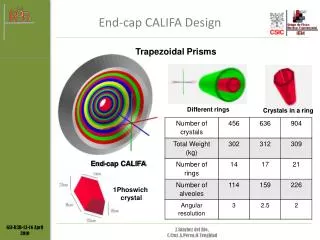
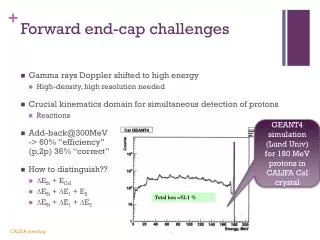
Forward end-cap challenges • Gamma rays Doppler shifted to high energy • High-density, high resolution needed • Crucial kinematics domain for simultaneous detection of protons • Reactions • Add-back@300MeV-> 60% “efficiency”(p,2p) 36% “correct” • How to distinguish?? • ∆ESi + ECsI • ∆ESi + ∆E1 + E2 • ∆ESi + ∆E1 + ∆E2 GEANT4 simulation (Lund Univ) for 180 MeV protons in CALIFA CsI crystal Total loss =52.1 % CALIFA meeting
Ep= 200MeV 30mm LYSO DE = 67.5±1.8 MeV 200±7MeV (sE/E=3.5%) Ep= 200MeV 20 mm LaBr DE = 31 ± 1 MeV 200±10MeV (sE/E=5%) Phoswich: p- Energy resolution E DE1+s (DE1) DE2+ s (DE2) • Protons: Using two DE-detectors one can determine the full proton energy with a resolution of <5%. • Gammas: Second detector placed to solve the ambiguity on the signal E =f(D E1 )+ g(D E2)
Phoswich prototype – gamma response Conventional electronics Sampled (1 Gs/s) anode pulse FWHM 2.4%@ 662 keV CALIFA meeting
Phoswich prototype – proton response Pulse integral [a.u.] 180+155 MeV protons Pulse height[a.u.] Sampled (1 Gs/s) anode pulse decay time= 16(LaBr)/28(LaCl) ns CALIFA meeting
Tracing protons… 100 – 190 MeV 190 MeV 190 – 400 MeV 100 MeV 0-100 MeV IWM2009 – Nov. 5 2009