Starter 10-29-13
This educational resource explores the fundamental concepts of heat transfer in the Earth's atmosphere and oceans. Through group activities and hands-on dissections, students will observe the anatomy of grasshoppers while learning about energy dynamics. Key topics include conduction, convection, and radiation, emphasizing the role of solar energy in driving weather patterns. The resource also discusses phenomena such as El Niño and La Niña, illustrating their impacts on global climate and weather systems.


Starter 10-29-13
E N D
Presentation Transcript
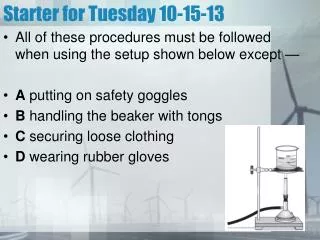
Starter 10-29-13 The anatomy of grasshoppers is being studied in a dissection lab. Working in groups of three, students make observations using a hand lens, forceps, and a scalpel. Two of the students in a group have finished their observations. These two students may do all of the following except — • A remove their goggles • B review their notes • C wash their hands • D assist their lab partner
Energy – What is it? Energy from the sun drives weather. Energyis the ability or capacity to do work on some form of matter.
Heat Transfer in the Atmosphere • Heat transfers from high to low temps. • There are three means: • Conduction • Convection • Radiation
Conduction • Conduction occurs when heat is transferred by DIRECT CONTACT • Solids including wet soil are good conductors
Conduction On Earth Seafloor spreading Melting of a plate
Convection • Fluid movement carries heat with it • Heated air is less dense, expands, and rises • Cooler, denser air sinks to replace warm air – completes convective cycle. • Convection: movement of molecules within fluids caused by heating and cooling
Convection on Earth Ocean currents Atmospheric circulation Wind/weather patterns Plate tectonics (convection in the mantle)
Solar Radiation **All matter emits energy as long as its temp. greater than 0K (this is called radiation)** • Radiation from sun is solar radiation • Solar energy travels through space via electromagnetic waves • Ex: greenhouse effect
“El Niño” • abnormal warming of surface ocean water in the Eastern tropical Pacific • Warmer climate results • Causes more rainy weather and bigger storms to the East (North and South America) and droughts to the West (Australia and Asia)
“La Niña” • abnormal cooling of surface ocean water in the Eastern tropical Pacific • Cooler climate results • Causes more rainy weather and bigger storms to the West (Australia and Asia) and droughts to the East (North and South America)