Arctic Tundra, Coniferous Forest, Temperate Deciduous Forest, Tropical Rainforest, Temperate Rainforest, Temperate Grass
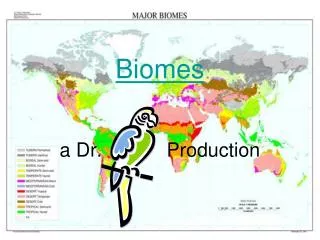
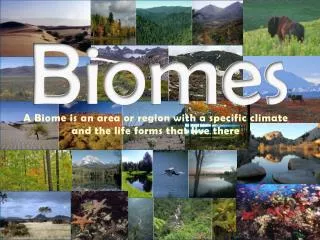
Explore the diverse biomes of the world, including the Arctic Tundra, Coniferous Forest, Temperate Deciduous Forest, Tropical Rainforest, Temperate Rainforest, and Temperate Grasslands & Tropical Grasslands. Learn about the unique characteristics, plant and animal species, threats, and adaptations of each biome.

Arctic Tundra, Coniferous Forest, Temperate Deciduous Forest, Tropical Rainforest, Temperate Rainforest, Temperate Grass
E N D
Presentation Transcript
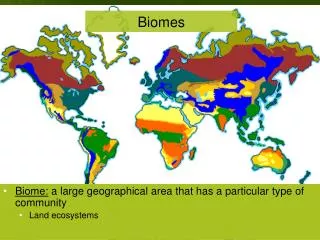
Location Arctic Tundra • About 55o to 70o North latitude
What “Controls” This Biome? Arctic Tundra • Long winters & short summers • Growing season for plants is often 8 weeks or less therefore this limits growth Unique Information or Adaptations • Permafrost exists there (ground is permanently frozen below the ground surface) • Trees can’t grow in tundra due to permafrost
Typical Species Arctic Tundra • In the summer, area above permafrost melts & ground becomes spongy • Lots of wetlands here that breed thousands of insects & attract lots of migratory birds • Caribou & herd animals, arctic fox, snowy owl, lemmings, grizzly bears (fig. 6-26)
Threats to this Biome Arctic Tundra • Oil & Gas exploration & drilling • Climate Change
Coniferous Evergreen Forest Other Names: Boreal Forest or Taiga Location • Just south of the Arctic tundra in the northern hemisphere
Coniferous Forest What “Controls” This Biome? • Cold & long winters (sun shines 6-8hrs/day) • Short cool summers (sun shines 19 hrs/day) • Low precipitation • Growing season for plants is short
Coniferous Forest Unique Information or Adaptations • Needles of trees have waxy coating to help keep moisture in the plant • Needles decompose slowly and cause the soil to be acidic & nutrient poor • Low plant diversity (few species can survive w/ frozen soil moisture)
Typical Species Coniferous Forest • Primarily Coniferous Evergreen Trees • Black Spruce, White Spruce, Balsam Fir, also may have Paper Birch, and Quaking Aspen • Bears, Wolves, Moose, Beaver, Owls
Coniferous Forest Threats to this Biome • Deforestation • Climate Change
Temperate Deciduous Forest Location • Eastern US, China & much of Europe
Temperate Deciduous Forest What “Controls” This Biome? • Moderate average temperatures that change significantly with the season • Abundant precipitation throughout the year • Long & warm summers & cold but not severe winters • Thick layer of leaf litter (nutrients!)
Unique Information or Adaptations Temperate Deciduous Forest • Fairly low rate of decomposition & lots of nutrients w/ fallen leaves • Penetration of more sunlight and high precipitation support variety of ground-level plant life
Typical Species Temperate Deciduous Forest • Broadleaf Deciduous Trees • White-tailed deer • Lots of birds • Mice, frogs, squirrels, rabbits, opossums, raccoons
Temperate Deciduous Forest Threats to this Biome • Deforestation, habitat loss & fragmentation • Replacement of old-growth forest with tree plantations
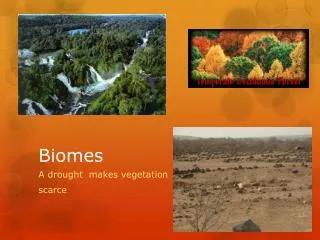
Tropical Rainforest Location • Northern South America, Southern Central America, SE Asia, Equatorial Africa
Tropical Rainforest What “Controls” This Biome? • Warm annual temperature with heavy rainfall almost daily • Most nutrients are in the plants/animals – not in the soil • Soil nutrients limit growth as temperature & water are not limiting • Rapid decomposition
Tropical Rainforest Unique Information or Adaptations • Lots of biodiversity • Highly stratified • Lianas – hanging vines have developed a twisting adaptation to survive the pulling between trees with the wind • Green tree snakes – camouflage • Epiphytes – “air plants” (some are bromeliads) • Buttresses – large base of trunk of a tree • Shallow roots so buttress helps support tree • Also captures nutrients when it rains
Tropical Rainforest Typical Species • Broadleaf Evergreen • High diversity of trees here Threats to this Biome • Deforestation
Temperate Rainforest Other Names: Coastal Coniferous Forest Location • Coastal area of Alaska
Temperate Rainforest What “Controls” This Biome? • Coastal areas with ample rainfall or moisture from dense fogs • Winters are mild & summers are cool
Unique Information or Adaptations Temperate Rainforest • Nearness to oceans moderates the temperatures • Trees depend of frequent rains & moisture from summer fog
Temperate Rainforest Typical Species • Large Conifers • Sitka Spruce • Douglas Fir • Redwoods Threats to this Biome • Deforestation
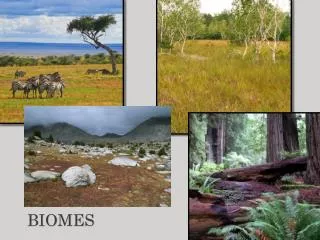
Temperate Grasslands and Tropical Grasslands Other Names: Prairies Tall Grass Short Grass Pampas Savanna – Tropical Grassland
Temperate Grasslands and Tropical Grasslands Location • Varies widely but in the interiors of continents
Temperate Grasslands and Tropical Grasslands What “Controls” This Biome? • Cold winters • Hot & dry summers • Uneven precipitation through the year 10-40 inches or so
Temperate Grasslands and Tropical Grasslands Unique Information or Adaptations • Fires in summer & fall are often • Fires keep trees out • Tropical Grasslands may have occasional deciduous tree • Flat top acacias (Lion King) • Eucalyptus in Australia • Prairie plants regenerate after fire due to their deep roots • Organic matter accumulates to produce a deep fertile soil • Soil held in place by thick network of roots
Typical Species Temperate Grasslands and Tropical Grasslands • Grasses • Beetles • Insects • Prairie Dogs • Tropical Grassland • Large herds of grazing & hoofed animals • Gazelles • Zebras
Threats to this Biome Temperate Grasslands and Tropical Grasslands • Plowing • Agriculture • Overgrazing by domesticated animals
Chaparral Other Names: Temperate Shrubland Location • Varies widely
What “Controls” This Biome? Chaparral • Mediterranean climate • Winters are mild • Moderate rain in winter • Summers are long, hot & dry
Chaparral Unique Information or Adaptations • Fires are needed by this biome • Dense undergrowth of drought resistant shrubs that have large root systems • Dry brittle vegetation that is dormant in hot & dry season • Shrubs have a waxy coating on “leaves” to keep moisture in
Typical Species Chaparral • Scrub Oak • Spiny Evergreen shrubs Threats to this Biome • People Like to Live Here & put out fires
Location Desert • At about 30o of latitude where air has lost its moisture from the tropics
Desert What “Controls” This Biome? • An area where evaporation exceeds precipitation • Precipitation typically less than 10 inches per year & scattered unevenly throughout the year • Lack of water “controls” this biome
Unique Information or Adaptations Desert • Succulent plants – thorns & waxy coating to protect and keep moisture in • Animals – nocturnal & live in burrows • Rarely urinate & it may be crystals • Plants have • Shallow & wide roots • No leaves • Vegetation is sparse • Cover 30% of the earth’s land
Desert Typical Species • Succulents • Rattlesnakes • Roadrunner • Red-tailed Hawk
Threats to this Biome Desert • Deserts take a long time to recover • Tracks left by tanks practicing during WWII are still visible • Off-roading • Irrigated crops
Rain Shadow Effect • The up wind side of mountain ranges are very wet & dry downwind • Downwind sides are often deserts
Location Mountain Biome • Scattered all over the world
Mountain Biome What “Controls” This Biome? • Wide variety of various biomes as you go up in elevation • 100m gain in elevation = 100km change in latitude (not always)
Mountain Biome Unique Information or Adaptations • Wide variety of biomes on a single mountain
Threats to this Biome Mountain Biome • Rapidly increasing population • Increased extraction of timber & minerals • Dams • Skiing & tourism • Increase warfare in mountainous areas (guerilla warfare) • Climate Change