Download

1 / 14
140 likes | 267 Vues
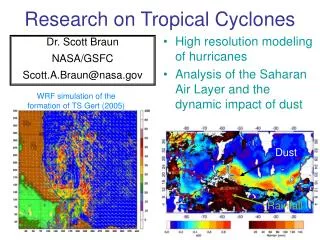
Analyzing the convective and stratiform characteristics of inner and outer regions in tropical cyclone rainbands using radar data, delving into tangential wind, reflectivity, secondary circulation, and momentum tendencies. Examining critical zones for secondary eyewall formation with insights on kinematic structures and jet dynamics.

E N D
Convective-scale variations in the inner-core rainbands of tropical cyclones Houze 2010 Anthony C. Didlake, Jr. and Robert A. Houze, Jr. 30th Conference on Hurricanes and Tropical Meteorology April 17, 2012
Hurricane Rita S t r a t i f o r m NCAR ELDORA radar 9/21/2005 1845-1927 Z 2 km reflectivity dBZ C o n v e c t i v e
Method of analysis • Divide into “inner” and “outer” regions • Classify pixels as “convective” or “stratiform” • Take radial cross sections across convective regions Inner Outer
Method of analysis • Divide into “inner” and “outer” regions • Classify pixels as “convective” or “stratiform” • Take radial cross sections across convective regions Inner Outer
Composite cross sections Tangential wind (m/s) – Shaded contours Reflectivity (dBZ) – Contour lines Secondary circulation – Vectors inner region outer region v (m/s) eye
inner region outer region v (m/s) Tangential wind u (m/s) Hence and Houze 2008 Radial wind
inner region outer region v (m/s) Tangential wind u (m/s) Radial wind
Vertical velocity (m/s) CAPE as a function of radius down total up Bogner et al. 2000 solid – inner dashed – outer
Tangential momentum tendency inner region outer region blue – radial advection red – vertical advection green – Coriolis term Altitude (km) acceleration (m s-2) acceleration (m s-2)
Tangential momentum tendency Total tendency D red – inner black – outer Altitude (km) Altitude (km) acceleration (m s-2) acceleration (m s-2)
9/21/2005 2010 Z Rainband convective cells Didlake and Houze 2012 9/22/2005 1800 Z Secondary eyewall Didlake and Houze 2011
Critical zone for secondary eyewall formation Rainband convective cells • Strong winds and low CAPE • Confinement of jet • Amplification via WISHE feedback • Inner edge subsidence Didlake and Houze 2012 Secondary eyewall Didlake and Houze 2011
Conclusions • Kinematic structure varies with radius • Tangential jet depends on radial and vertical advection • Inner cell jets constrained to low levels • Outer cell jets occur within large range of altitudes • Convective cells can reach critical zone of secondary eyewall formation
Acknowledgments • Michael Bell • Wen-Chau Lee • Stacy Brodzik • NDSEG Fellowship Program • NSF grant ATM-0743180