Topology
This article explores the implications of utilizing fewer than N^2 connections in network topologies. It discusses the feasibility of reduced interconnects, contentions, and lower bisection bandwidth, highlighting various topologies such as Token Ring, 2D Torus, Fat Tree, and Hypercube. The article compares Multi-Processor Parallel (MPP) networks, Local Area Networks (LAN), and Wide Area Networks (WAN), examining how design principles, distances, bandwidths, and overheads differ across these networks. It provides insights into routing methods and the significance of path selection strategies.

Topology
E N D
Presentation Transcript
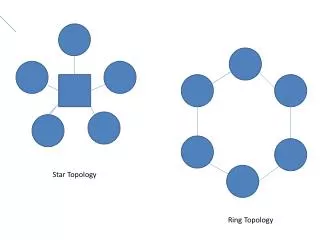
Topology • What are the consequences of using fewer than n2 connections? • Fewer interconnects make it practically feasible • Contention likely – lower bisection bandwidth • Other Topologies & worst case distances • Token Ring – N (N is no of nodes) • 2D torus - N • Fat tree – 2logN • 2D meshes 2N • Hypercube – Log(N/2) • Routing • Usually a random choice from no of equally good paths • Store-and forward vs. cut-through & wormhole forwarding
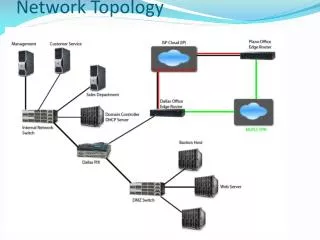
MPP, LAN, WAN • Compare and contrast the features. • MPP • Networks specifically designed, no standards • Use more novel and regular topologies • Smaller distances, high bandwidth and low overheads • Eg. CM-5 • LAN • Based on standards • Haphazard topologies evolved over years • Longer distance, emphasis on fault tolerance, large overheads • Eg. Ethernet • WAN • Based on standards • Simpler topologies than MPP • Very long distances, fault tolerant, large overheads • Eg. ATM