Understanding the Periodic Table: Elements, Families, and Properties
This section explores the unique characteristics of elements in the periodic table, including the significance of atomic numbers, protons, and electrons. It highlights hydrogen as the simplest element and discusses the organization of elements into families based on valence and properties. Additionally, it explains how elements are categorized as metals, non-metals, or metalloids, and provides insights on color coding for different states of matter. Understanding atomic numbers and how to visually represent elements is crucial for studying chemistry.


Understanding the Periodic Table: Elements, Families, and Properties
E N D
Presentation Transcript
Elements Pg 204-208
Elements • Element: __________________________________________________________________________ • The number of __________is something unique and therefore a characteristic property • The number of ___________can differ for each element • The number of _____________also differ from each element
Elements cont. • Hydrogen is the simplest element • It only has ____ proton and _____electron • It is also the ______________________
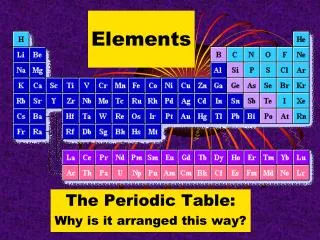
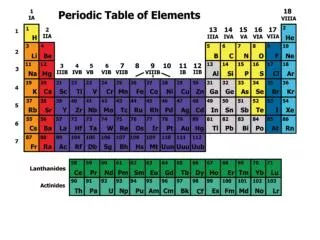
Periodic Table • Periodic Table: _______________________________________________________________________________________________________________________ • The elements ________________________________________________________________________________________________________________________ • The elements in the ____________________________________________________________________________________________________________________________________ • The elements in the ________________________________________________________________________________________________________________________________________________
Families • Each of the columns are a family (they all have names) • _____________________________________based on their Valence # and characteristic properties • There are 8 important families
Periodic Table cont. • Elements can be found in all three states in the periodic table • __________________ • __________________ • __________________ • Many periodic tables use colour coding to help you see the difference • In your textbook Solid = black, liquid = blue, gas = red
Periodic Table cont. • Staircase in the Table: the line that divides metals and non-metals • Metals : to the left of the staircase • Non-metals: to the right of the staircase • Metalloids: on the staircase • 6 total (in green in your textbook)
Periodic Table cont. • __________________________ • Atomic number (equal to the # of protons and electrons) • Chemical symbol • Name of element • You will need to know the first 20 elements plus: • Fe, Ni, Cu, Br, Ag, Sn, I, Au, Hg, U • ___________________________________________________________________________________________________________________________
How to draw your Element • By using the Atomic #, family/groupand period you can draw your element • Oxygen • Atomic # = 8 • Family = 6 • Period = 2 • 8 electrons • 6 electrons on the last ring • 2 rings total