Understanding Platyhelminthes, Nematoda, and Annelida: The Diversity of Worms
This chapter explores the fascinating world of worms across three major phyla: Platyhelminthes (flatworms), Nematoda (roundworms), and Annelida (segmented worms). It details their unique features, such as body structure, digestive systems, and modes of reproduction. Free-living and parasitic lifestyles are described, highlighting species like flukes, tapeworms, and nematodes that impact human health. The chapter also emphasizes the evolutionary significance of these creatures in the animal kingdom, showcasing their adaptations for survival in diverse environments.

Understanding Platyhelminthes, Nematoda, and Annelida: The Diversity of Worms
E N D
Presentation Transcript
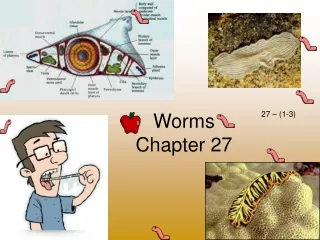
27-1 Flatworms • Phylum Platyhelminthes • Soft • Flattened worms • Have tissues of an internal organ system • Acoelomates • Only digestive cavity • Simplest animal to have • Bilateral symmetry (left to right) • Cephalization
Form and Function • Free-living • Organ systems for digestion, excretion, respiration and reproduction • Parasitic • Simpler in structure without (or with modified) internal organs ex. Fluke • All rely on diffusion for something
Form and Function • Feeding • Free-living • Carnivores- eat tiny aquatic animals • Protostomes • Pharynx- muscular tube pumps food into body • Parasitic • Feed on blood, tissues or pieces of cells • Obtain nutrients from food digested by host • Non-complex digestive system
Form and Function • Resp, Circ, and Excretion • Diffusion to transport oxygen and nutrients • Response • FL- head encloses ganglia- cells that control the nervous system • Eyespot- group of cells that detect change in light
Form and Function • Movement • FL- cilia help glide in water • Muscle cells allow twist and turn for reaction • Reproduction • FL- hermaphrodites • Sexual- exchange sperm then lay egg • Asexual- fission- organism splits in two and each becomes a complete organism • Parasitic- complex cycles between sexual and asexual
3 main groups of flatworms • Class Turbellaria • FL in marine or fresh water • Bottom dwellers in sand or mud • Great variation in color, form and size • Class Trematoda- flukes • Parasitic- infect internal organs of host • Schistosoma mansoni • Lives in humans, reproducing sexually • Burrow through exposed skin • Carried to blood vessels of intestines • Have an intermediate host in water- snail • Schistosomiasis- their eggs clog blood vessels- swelling
Class Cestoda- tapeworms • Parasitic, long, flat, live in intestines • No digestive tract- absorb through body walls • Scolex- head of an adult tapeworm with suckers • Proglottids- the segments that make up the body • Contain both male and female reprod. Organs • Egg is fertilized then they break off and burst
27-2 Roundworms • Phylum Nematoda • Slender, unsegmented with tapering ends • Pseudocoelom “false coelom” • Digestive tract with two openings • Undigestable food leaves through anus
Form and Function • Feeding • FL- predators use mouthpart • Some eat algae, fungi and decaying matter • Resp, Circ, and Excretion • Diffusion through body walls • Response • Ganglia • Sense organs- detect chemicals from prey
Form and Function • Movement • Hydrostatic skeleton • Move like snakes with muscle contraction • Reproduction • Sexually- separate genders • Internal fertilization
Human Diseases • Trichinosis • Caused by Trichinella • Live in intestines • Female releases larvae into bloodstream • Forms cysts and becomes inactive in muscles • Filarial worms • Live in blood and lymph vessels of birds and mammals • Transmitted through insect bites • Blocks the passage of fluids in lymph vessels • ex) Elephantiasis
Human Diseases • Ascarid • Ascaris lumbricoides • Causes malnutrition by absorbing digested food from small intestine of host • Carried in blood until it reaches the lungs then moves to throat and swallowed back in intestine • Hookworms • Use sharp plates and hooks to burrow into skin • Enter bloodstream • Cause weakness and poor growth
27-3 Annelids • Phylum Annelida “little ring” • Segmented worms • Segments are separated by septa • Each segment is specialized • True coelems made from mesoderm tissue • Mouth to anus digestive tract
Form and Function • Feeding and Digestion • Filter feeders to predators • Earthworms- pharynx moves food into esphogus to the • Crop- where the food can be stored, to the • Gizzard- where its ground into small pieces • Absorbed by the intestines
Form and Function • Circulation • Closed circulatory system- blood is contained in a network of blood vessels • Two major blood vessels- dorsal (tail to head) and ventral (head to tail) • Dorsal contracts rhythmically and pumps like a heart • Respiration • In water, breathe through gills • On land, the respire through moist skin
Form and Function • Excretion • Digestive waste passed through anus • Cellular waste passed by nephridia- excretory organs that filter fluids from coelem • Response • Brain and several well developed nerve cords • Sensory adaptations- tentacles, chemical receptors, statocysts, 2+ pairs of eyes
Form and Function • Movement • Hydrostatic skeleton • Longitudinal muscles- from front to back contract • Circular muscles- around each segment, long, thin • Marine- use parapodia for swimming/crawling • Reproduction • Sexually (most)- external fertilization- diff sexes • Earthworms and leeches- hermaphrodites • Clitellum- mucus ring where egg and sperm are release for fertilization– it slips off to protect eggs
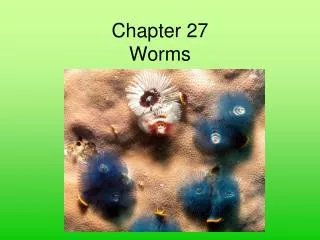
Groups of Annelids • Class Oligochaeta “few hairs” • Earthworms- streamlined with little setae • Live in soil or fresh water • Class Hirudinea- leeches • External parasite- sucks blood and fluid from host • Uses suckers to slice and proboscis to suck • Used to reduce swelling, pressure and clotting • Class Polychaeta “many hairs • Sandworms, blood worms • Marine with paired appendages with setae