Understanding Our Solar System: Planets, Moons, and Beyond
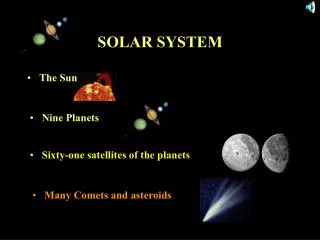
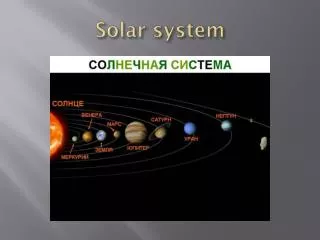
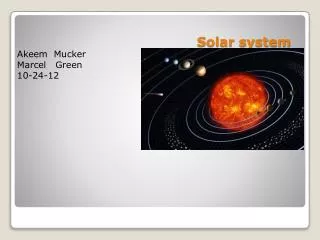
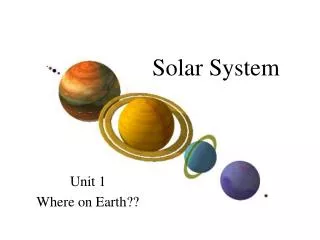
Dive into the fascinating world of our Solar System, where the Sun shines as the central star and planets, moons, and dwarf planets orbit around it. Learn about the four inner terrestrial planets—Mercury, Venus, Earth, and Mars—and the gas giants—Jupiter, Saturn, Uranus, and Neptune. Discover the Asteroid Belt between Mars and Jupiter, its dwarf planet Ceres, and the icy Kuiper Belt where comets are born. Explore how gravity influences orbits and the unique characteristics of each celestial body in this cosmic neighborhood.

Understanding Our Solar System: Planets, Moons, and Beyond
E N D
Presentation Transcript
Solar System What you need to know Where we live in Space
The Sun Sol= Sun Hydrogen + Helium
Planets Inner Planets Outer Planets
Mercury Terrestrial Not the hottest planet Closest planet to sun
Venus Terrestrial Closest in size to Earth Hottest Planet
Mars Terrestrial Last Inner Planet Has two Satellites (moons)
Asteroid Belt Between Mars and Jupiter
Asteroid Belt Small Irregularly shaped objects
Asteroid Belt Contains the Dwarf Planet Ceres
Outer Planets Gas Giants
Jupiter Largest Planet in Solar System 50 Regular Moons 14 Provisional Moons
Saturn Rings are made mostly of ice
Uranus Rotates on its side
Neptune Blue Color is from Methane Gas
Kuiper Belt Small icy objects Dwarf planets Some comets come from here
Pluto Dwarf Planet
Comets Rock and Ice Tail when close to Sun Elliptical Orbits
Oort Cloud More icy objects and comets End of Solar System
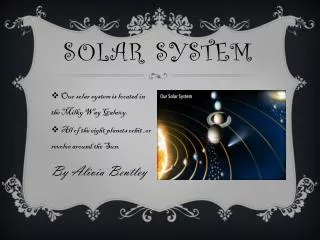
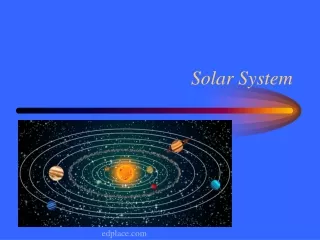
Orbits Planets orbit/revolve around Sun Planetary orbits are roughly circular Satellites revolve around planets. Planets rotate on their axes
Orbit Elliptical orbits
Gravity Force acting on objects Sun’s gravity keeps planets orbiting it Planets’ gravities keep satellites orbiting
Earth orbits Gravity No Gravity= Earth flies straight out Sun
Credits • FOSS • Wikipedia • NASA Kids