Download
1 / 28
280 likes | 431 Vues
The NOAA Space Weather Prediction Center (SWPC) provides vital services and products for monitoring and forecasting space weather phenomena including solar flares, radiation storms, and geomagnetic storms. Located in Boulder, Colorado, the SWPC conducts operational analysis, predictive modeling, and information dissemination. Key observations include data from instruments such as GOES, ACE, and SDO. The center also maintains partnerships with agencies like NASA and ESA to enhance its capabilities, offering alerts and warnings to stakeholders in aviation, power generation, and more to mitigate space weather impacts.

E N D
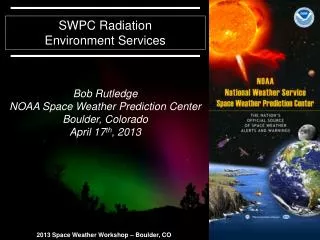
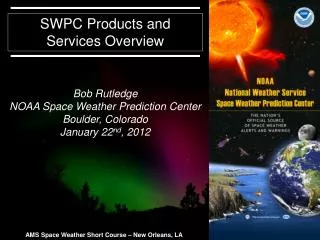
SWPC Products and Services Overview Bob Rutledge NOAA Space Weather Prediction Center Boulder, Colorado January 22nd, 2012 AMS Space Weather Short Course – New Orleans, LA
Outline • SWPC Overview • Key Observations and Measurements • NOAA Space Weather Scales • Solar Flares (R Scale) • Radiation Storms (S Scale) • Geomagnetic Storms (G Scale) • Sequence of Events • Products and Services • Information Dissemination Methods • Near-term Changes
SWPC Overview • Space Weather Forecast Office – Operational Functions: Analysis, prediction, product issuance, customer and media interactions • Development and Transition Section – Development and support of operational applications including data, models, and higher level products • Applied Research and Space Weather Prediction Testbed – Evaluation of methods, models, technologies; applied research; support for model transition to operations • Office of the Director: Center operations and stakeholder interactions • Technical Support Branch: IT, infrastructure, 24/7 system support
Key Observations & Measurements • NOAA Operational Measurements - GOES: • Solar Imagery (SXI) • Whole-disk X-ray output (XRS) • Geosynchronous magnetic field and particle measurements (LEO from POES) • USAF Observations and Measurements: • Optical: Spot reports and flare report • Radio: Radio bursts and sweeps • External Agency Partnerships: • NASA: ACE, STEREO, SDO, etc. • ESA/NASA: SOHO – Imagery and coronograph • United States Geological Survey: Geomagnetic observatories • National Solar Observatory: Global Oscillation Network Group (GONG) • Ground-based solar observatories, GPS measurements, and the list goes on…
NOAA Space Weather Scales Radiation Storms Geomagnetic Storms http://www.swpc.noaa.gov/NOAAscales/ Radio Blackouts
Sequence of Events Conditions are Favorable for Activity (Probabilistic Forecasts) Event Occurs Coronal Observations
Sequence of Events Event Onset/ Ground-Based Observation Analysis and Prediction ACE Observation
Event-Driven Product Definitions • Watches; The conditions are favorable for occurrence • Warnings; disturbances that are imminent, expected in the near future with high probability • Alerts; observed conditions meeting or exceeding thresholds
Solar Flares (Radio Blackouts – R Scale) • Arrival: 8 minutes, photons • Duration: Minutes to 3 hours • Daylight-side impacts • Probabilistic 1, 2, 3-day forecasts • Alerts for exceeding R2 (only) • Summary messages post-event
Solar Flare (Radio Burst) Impact on GPS – 6 Dec 2006 ~10 mins
Solar Radiation Storms (S Scale) • Arrival: 10’s of minutes to several hours • Duration: hours to days • Short-term warnings pre-onset • Alert for threshold crossing • Summary post-event
Geomagnetic Storms (G Scale) • Coronal Mass Ejections (CMEs) create geomagnetic storms • Arrival: ~18 – 96 hours • Duration: Hours to a day or two • Creates ionospheric storms, geomagnetically induced currents, aurora • 1-2 Day watch products based on coronagraph observations and modeling • Short-term (15 -60 min) warnings based on measurement at ACE spacecraft
GPS IMPACT – U.S. Federal Aviation Administration (FAA) Wide Area Augmentation System (WAAS) • Intense geomagnetic and ionosphere storms occur on 29 and 30 Oct, 2003 • Acceptable vertical error limits were exceeded for 15 and 11-hour periods METERS
Impacts on Electric Power Grid • CME impacts Earth’s magnetic field • Fluctuations generate electric fields on • Earth. These geomagnetically induced • currents (GIC) can flow into power lines • and transformers • Leads to transformer • saturation and • over-heating, voltage • drops, transformer • damage, or protective • device trips Transformer winding failure Transformer exit-lead overheating
Worst Case… …but is it a 100 year storm…200 year…?
Solar Cycle Predictions • Cycle 23 began in May 1996 • Peak in April 2000 with SSN = 120 • Solar Minimum in December 2008 • Solar Cycle 24 Underway
Information Dissemination • Phone Contact for Critical Stakeholders: NASA, Commercial Airlines, Power Generation and Distribution, FEMA, etc. • Product Subscription Service: Email-based, no cost subscription service open to all (first thing to go out) • Website: Data, products, and models all available there. Tops News heading that will provide updates for elevated space weather • AWIPS: product IDs @ http://www.swpc.noaa.gov/alerts/AlertsTable.html • Facebook: Active updates and education, secondary to official product dissemination means
Near-term Changes • Website overhaul underway • New look and feel, modern content management system • More user-friendly, updated content • Updated forecast products • Two forecasts per day with option for out-of-cycle, activity-driven updates • Forecast discussion with plain-language synopsis and explanation of rationale • Ovation Prime Auroral Model transition to operations • Continued improvement of geomagnetic storm products showing better nowcasts of regional disturbance information
NOAA Space Weather Prediction Center Boulder, Colorado www.spaceweather.gov