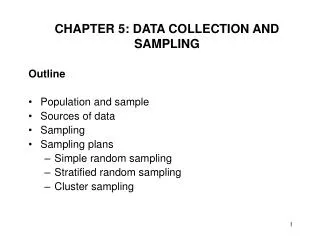
Field Collection and Sampling
Learn how to start your collection, what to sample, considerations, methodology, and natural history. Understand tools, techniques, storage, and factors to optimize biological sampling.
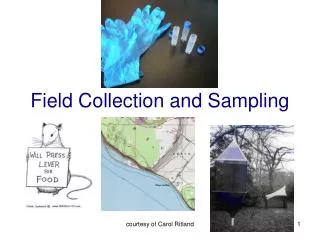

Field Collection and Sampling
E N D
Presentation Transcript
Field Collection and Sampling courtesy of Carol Ritland
Starting your collection • What to sample: Tissue • What to consider: Age, Season • What methodology to used for your biological questions • What is the natural history of your organism eg. Life history etc. http://images.google.ca/imgres?imgurl=http://www.christiananswers.net/kids/animals6.jpg&imgrefurl=http://www.christiananswers.net/kids/find2.html&h=375&w=500&sz=70&hl=en&start=5&usg=__d6sSz-0SC0vP_NuogTY5sRsvsxY=&tbnid=a9-2ftNtkcqeBM:&tbnh=98&tbnw=130&prev=/images%3Fq%3Danimals%26gbv%3D2%26hl%3Den%26client%3Dfirefox-a%26rls%3Dorg.mozilla:en-US:official%26sa%3DG
Starting your collection….cont’d • Check for permission and necessary permits for sampling • Check for location of field sites • Check on logistics of field collection http://www.monkeygrove.com/scribbles/2002/PaperWork.gif
Conifer abundance: affect on soil richness Photos = L. Ritland courtesy of Carol Ritland
Starfish abundance: affect on barnacles Photos = L. Ritland
What should you collect? • What could you collect? • Where would you collect? • When would you collect? • 5) How would you collect? • How much would you collect? • 7) Why did you collect them?
Tissue (Always go fresh if possible): • Plant: Seed, Leaves, Flower, Pollen, Bark, Xylem, Roots • Animal: Reproductive tissue, muscle, skin, hair, scat, blood, ear/toe/tail clip, fin, tooth, sloughed skin, saliva • Fungal: Hyphae, spores, fruiting bodies • Bacterial: single isolate culture • Destructive vs Non Destructive methods
Factors to consider when collecting: • Age: • Plant = actively growing material such as apical points, seedlings • Animal = actively dividing tissue (buccal and blood cells) • Fungus = young fruiting bodies (pure culture) • Bacteria = liquid culture • Season: • For conifer = use early spring bud burst especially for DNA markers
How to sample: • Sampling schemes: • Linear • Quadratic squares • Distance between samples • For animals: migration, reproductive strategies, life cycle • For plants: clonality, roots, reproductive strategies, life cycle • Consult a statistician? (Gene expression studies) courtesy of Carol Ritland
Sampling cont’d • Tools for sampling: • Ideally flash freezing samples with liquid nitrogen and transportation under ultra low temperature • Clean and if possible sterilize collection tools between samples • Pack samples with foil or proper containers eg. cryovials • Label all samples with non water based ink and protect with clear tape/paper and pencil courtesy of Carol Ritland
Liquid nitrogen vapour tanks courtesy of Carol Ritland
Ultralow temp. Liq N2 tanks • Pending on size • Ultralow temp can last from 10 days to 3 weeks • Can be used on aircrafts courtesy of Carol Ritland
Use sterile technique when sampling • Keep meticulous records • Identify any problems in the field for given sample • Do not depend on your memory alone courtesy of Carol Ritland
Long Term Storage: • Ideally all tissues should be kept at ultra low temperature (minus 70 to 80°C) • Certain tissues (blood, animal tissues cut into small pieces <1mm2 ) could be stored in 100% ethanol and saturated EDTA • Plants (small amounts) could be desiccated with lots of silica beads with lots of changes of beads courtesy of Carol Ritland
No No..s • Items to avoid: • Unnecessary chemicals eg. Formalin • historical samples that has been treated with fixatives • degraded samples • freezing and thawing of tissue • freezer burn (improper storage conditions) • improper inventory of samples courtesy of Carol Ritland
More to ponder….. • Items to consider: • For certain molecular marker (eg. AFLP, microarray) use the same tissue type (developmental differences could cause error when genotyping) • If possible collect all samples within a season over a same span of time (eg. For microarray analysis) • Collect more samples than required for pilot study and lost of samples courtesy of Carol Ritland