Understanding Atomic Bonding: Lewis Dot Diagrams and Electron Configuration
This guide explains atomic bonding, focusing on how atoms combine through their valence electrons, represented using Lewis dot diagrams. You'll learn about the significance of valence electrons linked to the periodic table's group numbers, exceptions, and the application of the octet rule for achieving stable electron configurations similar to noble gases. Additionally, we'll explore different types of bonds, including ionic and covalent bonding, using practical examples to illustrate these concepts effectively. Engage with the material and practice drawing Lewis diagrams for better understanding!

Understanding Atomic Bonding: Lewis Dot Diagrams and Electron Configuration
E N D
Presentation Transcript
Atomic bonding Why and How Atoms Combine Lewis Dot Diagrams
Lewis diagrams • When atoms combine, only electrons in the outer (valence) shell are involved. We can represent these valence electrons with Lewis diagrams. • On the next slide there is a diagram of the first 20 elements and their dot configuration: • We will only be worrying about these elements for now.
Here are the steps for writing Lewis Diagrams: • Write the element symbol. • Around this draw dots (One for each valence electron) • The dots should be spread over four sides. (Dots are not paired until all sides have at least one dot) • Lewis Dot Table
It doesn’t matter what side the dots are placed for example hydrogen can be written 4 different ways:
Check this out: • The number of valence electrons is equal to the group number. • For example, hydrogen is in group IA (group 1) and it has one valence electron. Neon is in 0 (group 8) and it has 8 valence electrons. • The only exception is He which is in group 8 but has 2 valence electrons. • Lewis Dot Table
Lets practice one together: • What would the Lewis Dot Diagram be for Ne? • Lets write down the symbol • Now how many valence electrons does it have? • Draw a dot for each valence electron
So how do we use this? • The Octet Rule: • When atoms form ions or combine in compounds they obtain electron configurations of the nearest noble gas (usually this means that there will be 8 outer electrons). • Nearest refers to the number of representative elements between an element and a noble gas.
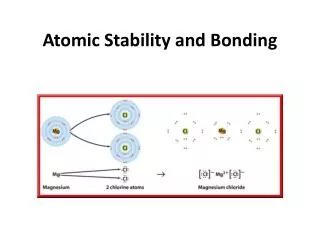
For example: • Br is 1 space removed from Kr, but 7 spaces removed from Ar (see your periodic table). • Therefore: Br would gain 1 electron to form Br–. • Similarly, Mg would lose 2 electrons to become Mg2+.
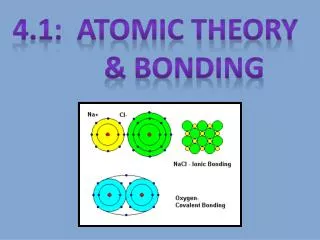
Types of bonds: • Ionic: occurs between metals and non-metals • Covalent: occurs between two non-metals • Alloys: we aren't worried about these at the moment
Tomorrow: • We will use the Lewis dot diagrams to display: • Ions • Ionic bonding • Covalent Bonding