Atomic Structure Preparing for Bonding
This document provides an essential overview of atomic structure, focusing on the three fundamental subatomic particles: protons, neutrons, and electrons. It details their mass, charge, and locations within the atom, emphasizing the principles of attraction and repulsion between charged particles. The text explores electron configurations within shells and orbitals, highlighting the rules for electron filling and the significance of achieving low-energy states. Additionally, it touches upon the dual behavior of electrons as particles and waves, and introduces key concepts necessary for understanding bonding in chemistry.

Atomic Structure Preparing for Bonding
E N D
Presentation Transcript
Atomic StructurePreparing for Bonding Douglas J. Burks BIO231 Wilmington College
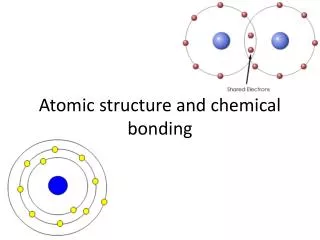
Basics • Three subatomic Particles • 1. Proton • A. Mass: ~ 1 AMU • B. Charge: +1 • C. Location: Nucleus • 2. Neutron • A. Mass: ~1 AMU • B. Charge: no net charge • C. Location Nucleus • 3. Electron • A. Mass: very small • B. Charge -1 • C. Location: in “orbits” • Opposite charge particles attract • Like charged particles repel • Systems want net neutrality • All systems want to be in lowest energy (most stable) http://education.jlab.org/qa/atom_model_02.gif
Electron Cloud • Property of Electron • With little mass • Dual behavior • Particle • Wave • Probability • 3 wave functions http://www.beyondbooks.com/psc92/images/00080041.jpg
Shells and orbitals • Shell http://www.chem.duke.edu/~bonk/Chem83/enotes/ElectAndAtoms01.gif
Basics • Periodic Table s p s p p p p p d d d d d d d d d d f f f f f f f f f f f f f f
Electron Filling • Rules • Lowest energy • No net charge • One electron per possible wave solution • Shell, orbital spin (two per orbital) • s (1 per shell) = 2 electrons • p (3 per shell) = 6 electrons • d (5 per shell) = 10 electrons • f (7 per shell) = 14 electrons • Shells • 1 has only s • 2 has only s and p • 3 has only s, p and d • 4 has s, p, d, and f • 5 has s, p, d, and f
http://www.webelements.com/webelements/properties/media/tables/balls/atomic-radius-emp.gifhttp://www.webelements.com/webelements/properties/media/tables/balls/atomic-radius-emp.gif