The Nervous System
The nervous system consists of the Central Nervous System (CNS) and the Peripheral Nervous System (PNS), with neurons being the fundamental units responsible for communication. Neurons detect changes, respond, and transmit information through pathways. Key components include the soma, dendrites, axon, and synapses, where signals are relayed between cells. The CNS, including the brain and spinal cord, governs vital functions, while the PNS connects sensory and motor pathways. Understanding these structures is crucial for studying how the body processes information and reacts to stimuli.

The Nervous System
E N D
Presentation Transcript
The Nervous System Central and Peripheral
What does a nerve cell do? • Detect change • Respond to change • Transmit the information to other cells which then can respond to and/or transmit the information
Neuron or nerve cell http://scienceblogs.com
What are the parts of a nerve cell? • Soma: the cell body • Dendrites: branching extensions off the body where information comes IN • Axon: Tail like extension off the body where information is conducted away from the body • Synapse: at the end of the axon where information goes OUT
A synapse is where 2 nerve cells meet Axon Dendrite http://www.coolschool.ca
What happens at a synapse? • Transmitters stored in vesicles • Impulse causes the vesicles to release the transmitters • Uptake into the dendrite of the next nerve continues the transfer of information • Excite or inhibit
A typical neuron has100,000 synapses http://www.mult-sclerosis.org
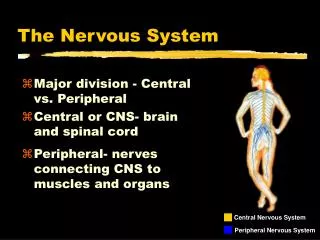
Divisions of the Nervous System • Central Nervous System (CNS) • Brain • Spinal cord • Peripheral Nervous System (PNS) • Somatic: Voluntary control • Autonomic: Involuntary control • Sympathetic • Parasympathetic
Brain: Fun Facts • 2 % of body weight (about 3 pounds) • Consumes 20% of our energy • Requires 20% of our blood • Requires 25% of our oxygen • Needs twice as much glucose as other cells • Can’t store any glucose
Parts of the Brain • Cerebrum controls reasoning, thought, memory, judgment, speech, sight, smell, hearing and voluntary control of the body. http://www.a2zpsychology.com
Parts of the Brain • Cerebellum controls muscle coordination, balance, posture and muscle tone http://www.nlm.nih.gov
Parts of the Brain • Brain stem is responsible for heart rate, breathing, swallowing, coughing, and blood pressure http://static.howstuffworks.com
Nerve cells • Detect change • Respond to change • Transmit information to other nerves • All of the above
All are parts of a nerve EXCEPT • Soma • Dendrite • Contractile filament • Axon and myelin
The cerebrum • Controls balance • Control judgment • Controls breathing • Controls heart rate
When a cop asks a drunk to touch his nose, he is testing his • Brain stem function • Cerebral function • Cerebellar function • Frontal lobe function
When a person stops breathing because of a overdose, the drug has effected his • Cerebrum • Cerebellum • Brain stem • Lungs
Spinal Cord • Carry messages up the cord to the brain • Carry messages from the brain down 3. Relay reflex action Damage to the cord Causes severe problems
Peripheral Nervous System • Afferent nerves: Carry information from the sense organs* to the spinal cord • Efferent nerves: Carry information away from the spinal cord to the muscles • pain, hot, cold, pressure, vibration
How neurons control muscles Axons synapse with a muscle fiber
Two possible routes • Sensation Afferent N Spinal Cord Brain Spinal Cord Efferent N Muscle • Sensation Afferent N Spinal Cord Efferent N Muscle Why do you think that information would be processed in the cord and not in the brain? Under what circumstances?
http://www.biotopics.co.uk What if I touch something hot?
Sensory Motor Reflex Arc http://www.frankswebspace.org.uk
Muscle Reflex Arc http://www.proprioception.co.uk
How muscles reflexes work http://faculty.etsu.edu
Autonomic system maintains involuntary functions • Sympathetic Fight or flight • Increase HR • Increase breathing rate • Increases blood pressure • Slows GI tract • Parasympathetic Calms • Slows HR • Decrease breathing rate • Decreases blood pressure • Increase GI activity
All information is processed in my brain • True • False
Information carried to the central nervous system is • Afferent • Efferent • Reflex
The correct order of a reflex arc is • Sensory n. to the spinal cord to motor n. • Motor n. to the spinal cord to sensory n. • Spinal cord to sensory n. to motor n. • Sensory n. to motor n.
Cranial Nerves I - Smell II - Visual acuity, visual fields and ocular fundi II,III - Pupillary reactions III,IV,VI - Extra-ocular movements, including opening of the eyes V - Facial sensation, movements of the jaw, and corneal reflexes VII - Facial movements VIII - Hearing and balance IX,X - Swallowing, elevation of the palate, gag reflex V,VII,X,XII - Voice and speech XI - Shrugging the shoulders and turning the head XII - Movement and protrusion of tongue