
SlideServe
Menu
Préférences
© SlideServe · v2026

RELATIVITY

lonna avatar
11 diapositives · 496 Views · Aug 09, 2014

RELATIVITY. Galilean Principle of Relativity. Any two observers moving at constant speed and direction with respect to one another will obtain the same results for all mechanical experiments. -Galileo Galilei. Albert Einstein.
RELATIVITY - slide 1
01 / 11RELATIVITY
1 / 17

Télécharger la présentation

RELATIVITY
Une image / un lien ci-dessous est fourni (tel quel) pour télécharger la présentation

Politique de téléchargement : le contenu du site vous est fourni TEL QUEL pour votre information et votre usage personnel ; il ne peut être vendu, concédé sous licence ni partagé sur d’autres sites sans l’accord de son auteur.Le contenu vous est fourni TEL QUEL, pour votre information et votre usage personnel uniquement. Téléchargez la présentation en cliquant sur ce lien. Lors du téléchargement, si vous ne parvenez pas à télécharger une présentation, l’éditeur a peut-être supprimé le fichier de son serveur.Pendant le téléchargement, si vous ne parvenez pas à obtenir une présentation, le fichier a peut-être été supprimé par l’éditeur.

F I N

Plus de contenu associé

Transcription de la présentation
  1. RELATIVITY

  2. Galilean Principle of Relativity Any two observers moving at constant speed and direction with respect to one another will obtain the same results for all mechanical experiments. -Galileo Galilei

  3. Albert Einstein Concerned with the lack of inner perfection in electromagnetic theory and created special theory of relativity. What would the world look like if I rode on a beam of light? 1879-1955; Germany, Switzerland, and USA

  4. Einstein’s Annus Mirabilis: 1905 Four Papers published while he was a patent clerk in Bern, Switzerland

  5. Postulates of Special Relativity • The Principle of Relativity – The laws by which the states of physical systems undergo change are not affected, whether these changes of state be referred to the one or the other of two systems in uniform translatory motion relative to each other. • The Principle of Invariant Light Speed – "... light is always propagated in empty space with a definite velocity [speed] c which is independent of the state of motion of the emitting body." (from the preface). That is, light in vacuum propagates with the speed c (a fixed constant, independent of direction) in at least one system of inertial coordinates (the "stationary system"), regardless of the state of motion of the light source.

  6. Lorentz Contraction • Einstein used the mathematical tools generated by HendrikLorentz in his 1905 paper on special relativity. • Lorentz maintained that the ether must exist. HendrikAntoonLorentz, (1853-1928) Netherlands

  7. Jules Henri Poincaré • Accomplished mathematician, physicist, engineer, and philosopher of science • Published the principle of relativity just before Einstein’s paper in 1905 and stated experiment cannot distinguish between states of uniform motion and rest • Poincaré took the Lorenz transformations and put them into a modern form • Poincaré never acknowledged Einstein’s work on special relativity and died before publication of the General Theory 1854-1912, France

  8. Consequences of the Postulates of Relativity • Time and distance are measured differently in different inertial frames. • Time is dilated and lengths are contracted in the direction of motion. • Thus, between two different inertial frames, measurements of time and distance are relative.

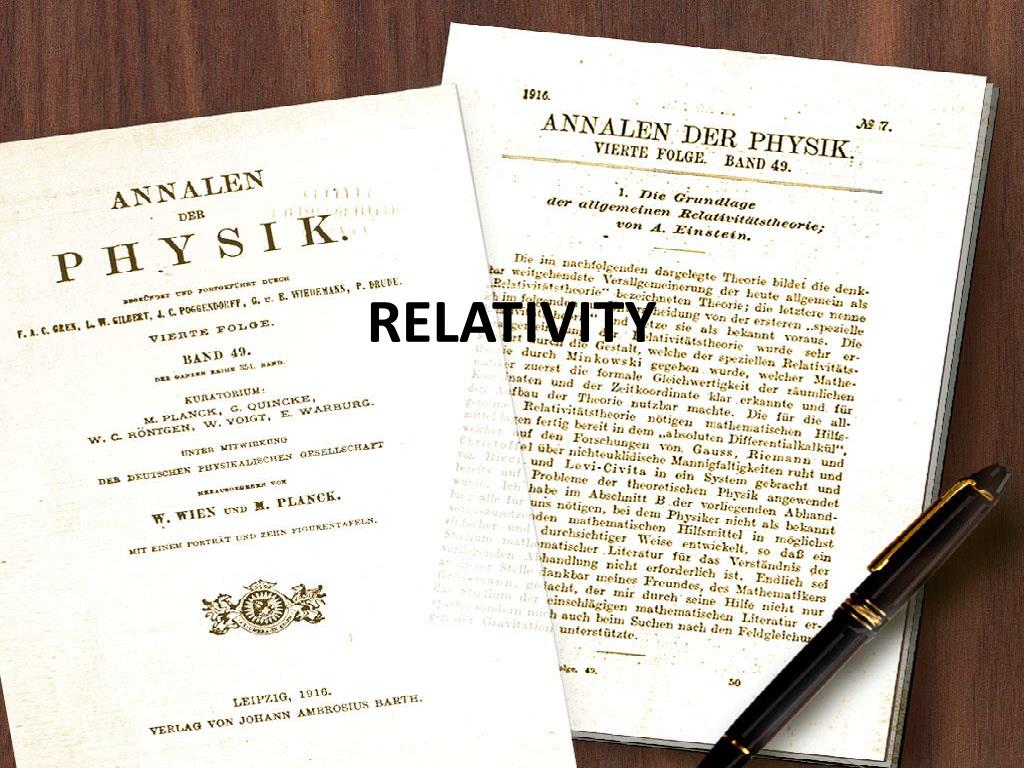
  9. The General Theory of Relativity • A theory about gravity in spacetime • Published in 1916 • Principle of equivalence

  10. Arthur Stanley Eddington • The earliest English-speaking physicist who used Einstein’s German science during WWI • Headed expedition to South Pacific to observe a solar eclipse on 29 May 1919 as a test of General Relativity 1882-1944; Britain

  11. GRAVTATIONAL LENSING