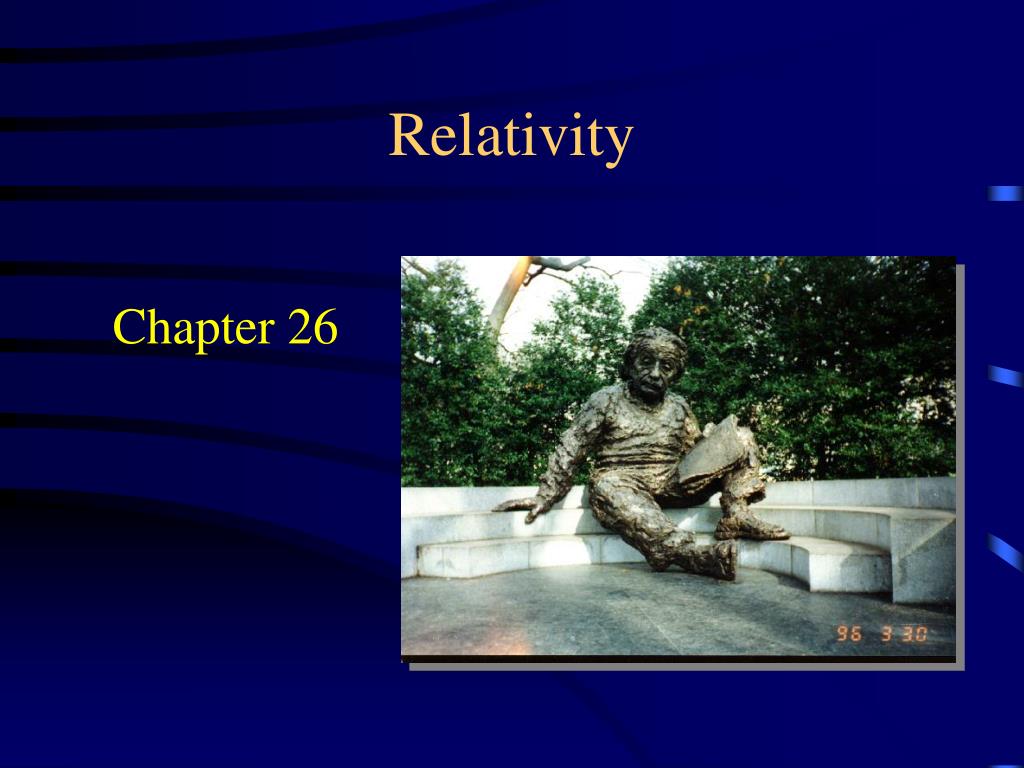
Relativity. Chapter 26. Introduction. Major Physics accomplishments by the end of the 19 th century Newton’s laws Universal gravitation Kinetic-molecular theory Laws of thermodynamics Maxwell’s theories which unified electricity and magnetism.
Une image / un lien ci-dessous est fourni (tel quel) pour télécharger la présentation
Politique de téléchargement : le contenu du site vous est fourni TEL QUEL pour votre information et votre usage personnel ; il ne peut être vendu, concédé sous licence ni partagé sur d’autres sites sans l’accord de son auteur.Le contenu vous est fourni TEL QUEL, pour votre information et votre usage personnel uniquement.Téléchargez la présentation en cliquant sur ce lien.Lors du téléchargement, si vous ne parvenez pas à télécharger une présentation, l’éditeur a peut-être supprimé le fichier de son serveur.Pendant le téléchargement, si vous ne parvenez pas à obtenir une présentation, le fichier a peut-être été supprimé par l’éditeur.
Introduction • Major Physics accomplishments by the end of the 19th century • Newton’s laws • Universal gravitation • Kinetic-molecular theory • Laws of thermodynamics • Maxwell’s theories which unified electricity and magnetism
The Speed of Light • Everyday speeds are much slower than the speed of light. • Newton’s laws describe the motion of objects at such speeds. • They don’t work with things traveling near the speed of light. • Newton’s laws don’t place a speed limit on particles.
Special Relativity • Einstein published his special theory of relativity in 1905, at age 26. • It was one of the greatest intellectual achievements of the 20th century. • He felt that it was simple and consistent in explaining deep contradictions in the old theories.
Relativity Postulates • Two postulates form the basis of the special theory of relativity. • The laws of physics are the same in all inertial reference systems. • The speed of light is constant and does not vary with the motion of the source or the observer. (c = 2.99 792 458 x 108 m/s)
The Principle Of Galilean Relativity • What is a frame of reference? • It is a set of objects that are assumed to be at rest with respect to the observedevent. • The laws of mechanics are the same in allinertial(non-accelerated) reference frames. • Newton’s law of inertia is valid.
Common observations • There is no preferred frame of reference for describing the laws of mechanics. • Examples: • A ball thrown straight up in a plane • A ball rolled across the aisle in a train • Galileo showed this in a boat.
The Speed Of Light Paradox • If relativity applies to Newtonian mechanics, does it also apply to electricity, magnetism, optics, and other areas? • The speed of light paradox • A pulse of light sent forward by an observer in a moving boxcar. 26.2
Resolving the paradox • Either: • The addition law for velocities is incorrect. • Or: • The laws of electricity and magnetism are not the same in all inertial frames.
The Speed Of Light • Does light require a medium to travel through? • The luminiferous ether theory of the 19th century said “Yes!”. • The ether was supposed to be a massless fluid in space. • Scientists tried to prove or disprove its existence.
The Michelson-Morley Experiment • It was designed to determine the existence of the ether. • It proved that there was no ether. • The Michelson interferometer did not detect any change in the speed of light when it was rotated 90o.
Consequences Of Special Relativity • Our basic notions of space and time must change. (Newton was wrong!!!) • There is no absolute length. • There is no absolute time. • Events at different locations that occur simultaneously in one frame are not necessarily simultaneous in another frame.
Frames of Reference • There is no preferred frame of reference. • Both observers are correct in their own reference frames.
Time Dilation • Example: A vehicle moving to the right at a speed v • The time measured by an observer in a stationary frame is longer than that measured by the moving observer in his own reference frame. • A moving clock runs more slowly than an identical stationary clock. 271, 26.8 272
Proper Time • Proper time (Dtp) • The time interval between two events as measured by an observer who sees the events occur at the same place. • Measured with a single clock at rest in the frame in which the events take place at the same position • All physical processes slow down .
Time dilation has been verified. • Unstable muons entering our atmosphere • They travel farther than they should. • Muons accelerated in the laboratory • They “live” 30 times longer. • Clocks in jets • Clocks with the lunar astronauts 269
Length Contraction • Proper length (Lp) • The length of the object measured in the reference frame in which the object is at rest • Relativistic length contraction (L) • The length contraction only takes place in the direction of motion. • Applications for space travel to the stars 26.11, 273
Conservation of Momentum • We must now generalize Newton’s laws of motion, and the definitions of momentum and energy. • Momentum is not always conserved if we always use p = mv. 267
Relativistic Momentum • Relativistic momentum must be conserved in all collisions. • As v approaches zero, relativistic momentum must approach classical momentum.
Relativistic Addition Of Velocities • Velocities can no longer be added together as we did in Newtonian mechanics. • Objects cannot travel faster than the speed of light. 268
Electron-Positron Pairs • The rest energy of an electron has already been found to be 0.511 MeV. • Therefore, the electron-positron pair would require a photon whose energy was at least1.02 MeV. • Gamma rays • Short wavelength x-rays