Enhancing First-Year Student Experience at UCD: Engaging Strategies and Best Practices
This presentation by Dr. Amanda Gibney outlines strategies for improving the first-year experience at University College Dublin (UCD). It discusses the Fellowship in Teaching and Academic Development and presents ten actionable steps aimed at fostering student engagement, enhancing academic skills, and supporting community building among first-year students. The program highlights specific initiatives, including peer mentoring and creative learning approaches adapted to various disciplines, ensuring a smoother transition to university life and promoting early student involvement.

Enhancing First-Year Student Experience at UCD: Engaging Strategies and Best Practices
E N D
Presentation Transcript
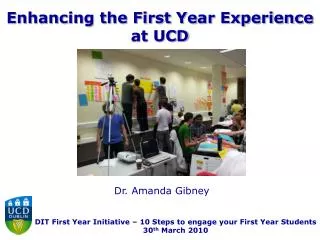
Enhancing the First Year Experience at UCD Dr. Amanda Gibney DIT First Year Initiative – 10 Steps to engage your First Year Students 30th March 2010
Outline of Presentation • Fellowship in Teaching & Academic Development • Education Strategy Development • Programme Planning • Focus on First Year • Semester 1 Engagement and Skills Development • Summary
Fellowship in Teaching & Academic Development • Scheme commenced 2007, 8 Fellows • Funded by HEA Strategic Initiative Fund (SIF1&2) • Creation of network of emerging leaders with T&L track record • Research key institutional education issues • Model: Group project and individual project • Dissemination of research findings and improvement of student experience
Fellowship in Teaching & Academic Development Group Project: First Year Experience Fellows Team: Niamh Moore, Sara O’Sullivan, Feargal Murphy & Amanda Gibney Findings Gibney, A., Moore, N., Murphy, F. & O'Sullivan, S. (2011) 'The First Semester of University Life; 'will I be able to manage it at all?'. Higher Education, 62 (3):351-366, DOI 10.1007/s10734-010-9392-9 (Web link: http://hdl.handle.net/10197/2788) • Recommendations • Initiatives to support transition • development of skills, engagement, drop-in writing centre • Initiatives to support community building • group work, peer mentoring, social networking
Education Strategy Development Consultation and development process 2009-2010 Development of Strategic Objectives Development of University, College and Programme actions Strategy launched in April 2010 as integral part of UCD Strategic Plan to 2014
Education Strategy Development • Strategic Objectives • Foster early and lasting student engagement • Grow and develop graduate education • Strengthen and enhance academic disciplines and programmes • Stimulate creativity, innovation, entrepreneurship and active citizenship • Widen participation and support lifelong learning • Internationalise the student experience • Excel in teaching, learning innovation and academic development
Programme Planning • University Level Planning (2009-2010) • (Registrar, Deputy Registrars, College Principals, VPTLs, Programme Deans, Graduate School Directors, Marketing and Recruitment Managers, Finance Managers) • Clear unified presentation of programmes, simplification of entry routes • Identification of common themes across programmes • Articulation of pathways from undergraduate to graduate programmes
Programme Planning • Programme Level Planning (2009-2010) • Oversight and Working Group • (Programme Deans, College Principals, VPTLs, Graduate School Directors, School Heads, School Heads of T&L, Programme Office Directors, College Finance Officers) • Programme vision • Programme outcomes and graduate attributes • Programme Structure/Map • Action plan and timelines
Focus on First Year • University Level Initiative (2010-2011) • University and Programme Orientation • Academic Programme Structure • Assessment and Feedback • Transition to Independent Study • Engagement with UCD
Semester 1 Engagement and Skills Development Programme Specific Modules Business: Effective Learning and Development Engineering: Creativity in Design Computer Science: Computer Science in Practice Science: Principles of Scientific Enquiry Nursing: Transitions: Engage to Success Arts: Learning for Success @ University (Module Descriptors: http://www.ucd.ie/students/course_search.htm)
Semester 1 Engagement and Skills Development Engineering: Creativity in Design (coupled with Innovation Leadership) • Active-learning engineering experience through which students develop their: • observation skills • problem solving skills • lateral thinking abilities • visual and verbal presentation skills • information literacy skills.
Semester 1 Engagement and Skills Development Innovation Process Observe Ideation Prototype Refine Understand Implement a-Ha! Small # Probable Solutions Points of Inspiration Opportunity Statement Ideas to Pursue Possible Solutions Innovative Solution • Data • Issues • Successes • Problem Def. • Shadowing • User Journey • User Interviews • Story Telling • Brainstorming • Lateral Thinking • TRIZ • Mock-ups • Go Fast • No Frills • Create Scenarios • Focus Prototypes • Engage Clients • Ruthless Decisions • Focus on Outcomes • Resourcing • Diverse Skills • Create • Launch Current Situation User Experience Idea Generation Working Models A Few Possibilities Solution
Semester 1 Engagement and Skills Development Assessment Group (85%) Formative and summative assessment in-studio wks 3 to 12 • 5 key concepts • Understanding (evidence-based, comprehensive) • Observation (planning, photos, sketches) • Idea generation (no. of ideas, good themes) • Prototyping (planning, testing, context) • Communication (verbal and visual) Individual (15%) Sketchbook submission, sketch exercises
Semester 1 Engagement and Skills Development Creative Design Solutions Exhibition Innovation Dublin 2010 & 2011
Semester 1 Engagement and Skills Development General Points • Students were provided with a module handbook • Students obtained weekly feedback (both formative and summative) • Students not attending studio sessions were contacted • Students exhibited sustained, substantial effort across the semester • Student’s understanding of the process and their prototyping, communication skills and confidence improved across the semester
Semester 1 Engagement and Skills Development Student Feedback • Aspects that appealed: • Teamwork, studio setting, solving real problems, getting to know classmates, fun, active • Aspects that helped learning: • Giving presentations, teamwork, interactive studio • Suggest changes: • More time per project, more drawing, earlier information literacy session, clearer project briefs, better chosen groups
Semester 1 Engagement and Skills Development Science: Principles of Scientific Enquiry • Aims • Engage students with scientific literature research • Encourage critical and analytical thinking • Encourage passion for discovery and with that self-motivated learning • Develop group work and communication skills • Provide a personalised contact with academics in the scientific community • Aid transition to university
Semester 1 Engagement and Skills Development Delivery Lectures: to full cohort of 400+, lecturer-led Workshops: groups of 75, tutor led Tutorials: groups of 5-6, academic as facilitator Group Work: groups of 5-6 scheduled unsupervised time
Semester 1 Engagement and Skills Development Assessment * Group marks weighted by peer marking and attendance and contribution mark
Semester 1 Engagement and Skills Development Observations and Feedback • Students engaged with scientific literature and aware of research activities in UCD and beyond • Students used research and critical thinking skills developed in other modules • Students’ communication skills improved as did their confidence • Students recognise longer-term benefits of skills developed
Summary • Co-ordinated, planned institutional activity in T&L supported at high level can effect real change • Institutional Research and research-based evidence will dispel anecdotal evidence and spur change • Cross-disciplinary dissemination/interaction pitched at appropriate level promotes wider adoption of innovative effective practices • Effective Fellowship model has: • - engaged academics in policy making • - developed cross-disciplinary networking • - resulted in emergence of academic leaders