METHODS Tag Testing Distance Sensitivity Orientation Sensitivity Effect of metal
10 likes | 149 Vues
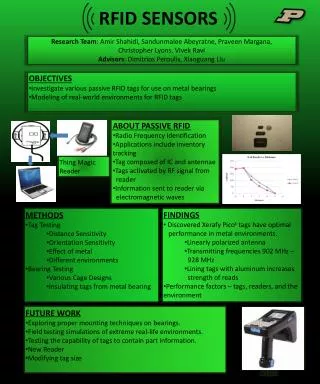
This research investigates the use of passive RFID tags in metal bearing environments, focusing on the performance of various tags like Xerafy Picox. Key objectives include modeling real-world conditions and testing factors such as distance and orientation sensitivity. Findings show optimal tag performance within the 902-928 MHz frequency range, enhanced by aluminum lining. Future work will explore effective mounting techniques, field testing under extreme conditions, and the ability of tags to store part information. This innovative approach could significantly improve inventory tracking in industrial settings.


METHODS Tag Testing Distance Sensitivity Orientation Sensitivity Effect of metal
E N D
Presentation Transcript
RFID SENSORS Research Team: Amir Shahidi, SandunmaleeAbeyratne, Praveen Margana, Christopher Lyons, Vivek Ravi Advisors: DimitriosPeroulis, Xiaoguang Liu • OBJECTIVES • Investigate various passive RFID tags for use on metal bearings • Modeling of real-world environments for RFID tags • ABOUT PASSIVE RFID • Radio Frequency Identification • Applications include inventory tracking • Tag composed of IC and antennae • Tags activated by RF signal from reader • Information sent to reader via electromagnetic waves Thing Magic Reader • FINDINGS • Discovered Xerafy Picox tags have optimal performance in metal environments. • Linearly polarized antenna • Transmitting frequencies 902 MHz – 928 MHz • Lining tags with aluminum increases strength of reads • Performance factors – tags, readers, and the environment • METHODS • Tag Testing • Distance Sensitivity • Orientation Sensitivity • Effect of metal • Different environments • Bearing Testing • Various Cage Designs • Insulating tags from metal bearing • FUTURE WORK • Exploring proper mounting techniques on bearings. • Field testing simulations of extreme real-life environments. • Testing the capability of tags to contain part information. • New Reader • Modifying tag size CS101