Download
1 / 52
520 likes | 650 Vues
This document outlines the immunization requirements for children attending licensed child care and preschools in Washington State. It explains the definitions of complete, conditional, and out of compliance statuses, and how to utilize the Washington State Immunization Information System for compliance verification. The required vaccinations, including DTaP, Hepatitis B, and MMR, along with details about the vaccination schedule and exemptions, are covered. For further assistance, contact Trang Kuss at the Department of Health.

E N D
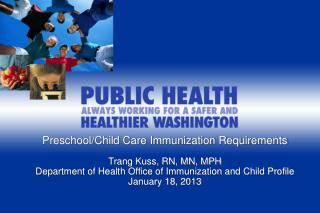
Preschool/Child Care Immunization Requirements Trang Kuss, RN, MN, MPH Department of Health Office of Immunization and Child Profile January 18, 2013 Implementing WA New State Exemption Requirements - Training for Schools and Child Cares/Preschools August XX, 2011
Contact Information Dept. of Health Office of Immunization and Child Profile Trang Kuss, RN, MN, MPH School and Child Care Coordinator trang.kuss@doh.wa.gov; 360-236-3760
Topics to be Covered • What are the child care and preschool immunization requirements in Washington State? • Complete, Conditional, Out of Compliance: What do they mean? • How can I use the Washington State Immunization Information System to help determine if a child is complete?
Immunization Requirements • Children attending licensed child care must comply with immunization requirements to protect the health of the public and individuals • Children must be vaccinated against certain vaccine-preventable diseases at ages and intervals according to the national immunization schedule • Parent must submit completed Certificate of Immunization (or Certificate of Exemption) • www.doh.wa.gov/CommunityandEnvironment/Schools/Immunization/Regulations.aspx
Examples of those not required to comply • Facilities not required to have a DEL license • Coop preschool • Birth to Three Program
Required Immunizations for Preschool or Child Care Attendance • DTaP • Hepatitis B • Hib • IPV • MMR • PCV • Varicella
Recommended, but Not Required • Hepatitis A • Rotavirus • Flu
Immunization Status • Complete/Fully Immunized • Conditional • Temporary status to allow child to get fully immunized • Out of Compliance • Exempt
www.doh.wa.gov/Portals/1/Documents/Pubs/348-051-ChildcareChart2013-2014.pdfwww.doh.wa.gov/Portals/1/Documents/Pubs/348-051-ChildcareChart2013-2014.pdf
www.doh.wa.gov/Portals/1/Documents/Pubs/348-284-IndividualVaccineRequirements.pdfwww.doh.wa.gov/Portals/1/Documents/Pubs/348-284-IndividualVaccineRequirements.pdf
DTaP Details • Routine schedule: 2, 4, 6, 15-18 months, and booster dose at 4-6 years • 6 months interval recommended between dose 3 and 4, but 4 months or more is acceptable • DTaP given to children less than 7 years of age; Td and Tdap given to children 7 years of age or older
What to do if: • If Tdap given for dose 1, 2, or 3 instead of DTaP Repeat with DTaP • If Tdap given for dose 4 or dose 5 instead of DTaP Acceptable
Note red X because Dose 4 given too early Dose 4 past due DTaP Example
Note red X – Tdap given as dose 2 DTaP Example
Hepatitis B Details • Routine schedule: birth, 1 month, and 6 months • Pay attention to min age for dose 3 and minimum intervals between doses
Hib Details • Routine schedule: 2, 4, 6, and 12-15 months • Not recommended for children 5 years or older • The recommended immunization schedule for Hib vaccines:
Hib Details • Unvaccinated children 7 months of age and older may not require full series. Total number of doses depends on child’s current age. • Final booster dose should be given at 12 months or older and a min of 8 weeks after previous dose.
Hib Details • One total dose for unvaccinated child 15-59 months of age. • Two doses total if Dose 1 given >12 months and Dose 2 given >15 months of age. • Three doses total if 2 doses given before 12 months and Dose 3 given >12 months.
IPV Details • Routine schedule: 2, 4, 6-18 months, and booster at 4-6 years. • IPV used routinely in US for polio vaccination, but students coming from a foreign country may get OPV • Any combination of IPV or OPV valid
MMR Details • Routine schedule: 12-15 months and 4-6 years • Dose 1 given <12 months of age must be repeated (4 day grace applies) • MMR or MMRV can be used • If not given on same day, minimum interval between MMR and varicella is >28 days • The second vaccine given is not valid and should be repeated
Note red X – MMR given 5 days too early MMR Example
Pneumococcal Conjugate (PCV) Requirement *Some children may get 5 total doses. A single supplemental dose of PCV13 is recommended, but not required, for all children aged 14–59 months who got 4 doses of PCV7.
PCV Details • Routine schedule: 2, 4, 6, and 12-15 months • A single supplemental dose of PCV13 is recommended, but not required, for all children aged 14–59 months who got 4 doses of PCV7 • PCV13 replaced PCV7 in 2010
PCV Details • 1 total dose only on or after 24 months unless high risk. • Two doses total if both received between 12-24 months, given >8 weeks apart. • Three doses total if 2 doses given <12 months and Dose 3 given at >12 months.
Katey is complete with 3 doses! PCV Example
Varicella Details • Routine schedule: 12-15 months and 4-6 years of age • If not given on same day, minimum interval between varicella and MMR is >28 days
Note red X – Varicella not given same day as MMR Varicella Example
4 Day Grace Period • Vaccines given <4 days before the minimum interval or age are valid • Applies to all inactivated vaccines before minimum intervals OR ages • Grace period applies if live vaccines given at the same visit
Dose 3 valid given 3 days before 6 months of age 4 Day Grace Example