Testing Muon Flux Variation with Altitude Using a Geiger Counter in Colorado
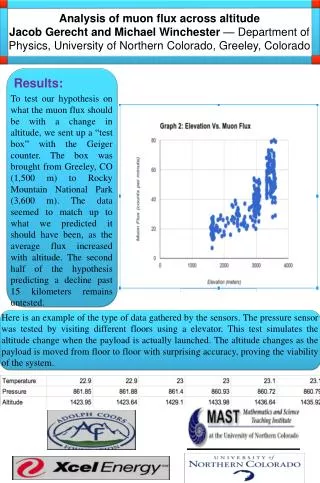
This study examines the hypothesis that muon flux increases with altitude, using a Geiger counter deployed in a "test box" transported from Greeley, CO (1,500 m) to Rocky Mountain National Park (3,600 m). The results showed a correlation between increased altitude and muon flux, aligning with our predictions. However, further testing is required to investigate the expected decline in flux beyond 15 kilometers. Additionally, pressure sensor data collected from various building floors demonstrated high accuracy in simulating altitude changes, validating the system's effectiveness.

Testing Muon Flux Variation with Altitude Using a Geiger Counter in Colorado
E N D
Presentation Transcript
23.5 in Results: To test our hypothesis on what the muon flux should be with a change in altitude, we sent up a “test box” with the Geiger counter. The box was brought from Greeley, CO (1,500 m) to Rocky Mountain National Park (3,600 m). The data seemed to match up to what we predicted it should have been, as the average flux increased with altitude. The second half of the hypothesis predicting a decline past 15 kilometers remains untested. Analysis of muon flux across altitude Jacob Gerecht and Michael Winchester — Department of Physics, University of Northern Colorado, Greeley, Colorado 35.5 in Here is an example of the type of data gathered by the sensors. The pressure sensor was tested by visiting different floors using a elevator. This test simulates the altitude change when the payload is actually launched. The altitude changes as the payload is moved from floor to floor with surprising accuracy, proving the viability of the system.