SlideServe
Menu
Préférences
© SlideServe · v2026

Ancient Egypt: Vocabulary Study Guide

lsonya avatar
27 diapositives · 292 Views · Jan 04, 2020

Dive into the rich history of ancient Egypt, from the Nile River Valley to the majestic pyramids. Discover hieroglyphics, pharaohs, mummies, and more. Uncover the secrets of this fascinating civilization.
Ancient Egypt: Vocabulary Study Guide - slide 1
01 / 27Ancient Egypt: Vocabulary Study Guide
1 / 17

Télécharger la présentation

Ancient Egypt: Vocabulary Study Guide
Une image / un lien ci-dessous est fourni (tel quel) pour télécharger la présentation

Politique de téléchargement : le contenu du site vous est fourni TEL QUEL pour votre information et votre usage personnel ; il ne peut être vendu, concédé sous licence ni partagé sur d’autres sites sans l’accord de son auteur.Le contenu vous est fourni TEL QUEL, pour votre information et votre usage personnel uniquement. Téléchargez la présentation en cliquant sur ce lien. Lors du téléchargement, si vous ne parvenez pas à télécharger une présentation, l’éditeur a peut-être supprimé le fichier de son serveur.Pendant le téléchargement, si vous ne parvenez pas à obtenir une présentation, le fichier a peut-être été supprimé par l’éditeur.

F I N

Plus de contenu associé

Transcription de la présentation
  1. Ancient Egypt:Vocabulary Study Guide

  2. Egypt • a country in northeastern Africa

  3. The Nile River longest river in the world Nile River delta a delta is a triangular-shaped area of soil at the mouth of a river

  4. The Nile River Valley • a lower elevation of fertile land found by the Nile River

  5. Lower and Upper Egypt Lower Egypt = northern part of Egypt Memphis was an important city on the Nile near the delta. Upper Egypt = region in Egypt south of the Nile delta

  6. siltis a mixture of soil, bits of clay, and small rocks

  7. Papyrus a plant whose stems are used to make a kind of paper

  8. Cataracts waterfalls found along the Nile River

  9. economy = how people use and manage their resources

  10. Hieroglyphics a form of writing based on pictures

  11. Rosetta Stone Scholars learned the meaning of hieroglyphics by studying the Rosetta Stone.

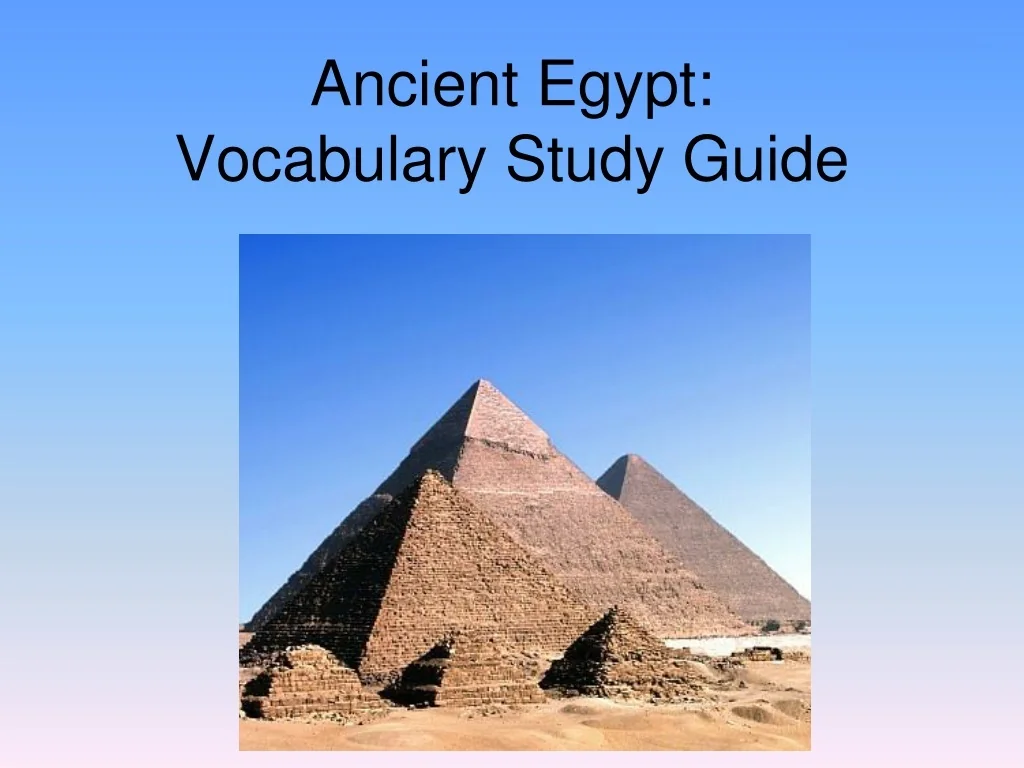
  12. Pyramids • huge stone structures • burial places for kings

  13. Giza and Khufu • Giza is the city in Egypt where the Great Pyramid is located • Khufu was the pharaoh who built the Great Pyramid

  14. Mummies A mummy is a preserved body.

  15. Pharaoh = Egyptian ruler(worshipped as a god-king)

  16. King Menes— he unified Upper and Lower Egypt Unify means to unite into one.

  17. Manetho • a priest and an advisor who began to keep records • Manetho divided the kings into different dynasties

  18. Hatshepsut • Hatshepsut was the daughter of a pharaoh who became a ruler of Egypt. She claimed that Ra was her real father.

  19. Nubia • a kingdom south of Egypt • Nubia is now known as Sudan

  20. Kush • Kush was a kingdom of Nubia • Amanirenas was Queen of Kushites (she led Kush into battle)

  21. independent • to be free

  22. Akhenaten • Egyptian ruler who changed his name from Amenhotep IV and called for the worship of one god, Aton

  23. Meroe • a capital city of Nubia

  24. Napata • the capital of the African kingdom of Kush

  25. Thutmose III • New Kingdom pharaoh who conquered Nubia and brought ancient Egypt to the height of its power

  26. Kashta • King of Kush who conquered Upper Egypt

  27. Piankhi • son of Kashta • he conquered the rest of Egypt