Download
1 / 40
480 likes | 1.18k Vues
Avalanches are natural disasters characterized by falling masses of snow and ice, posing significant threats to life, property, and transportation routes. They result from complex interactions involving terrain, weather, and snowpack dynamics. Knowing their formation factors is crucial for recreationists and communities alike. This overview discusses avalanche types, accident statistics, forecasting methods, and the latest research in avalanche management. Recognizing the risks and understanding how to mitigate them can enhance safety in both backcountry and ski area environments.

E N D
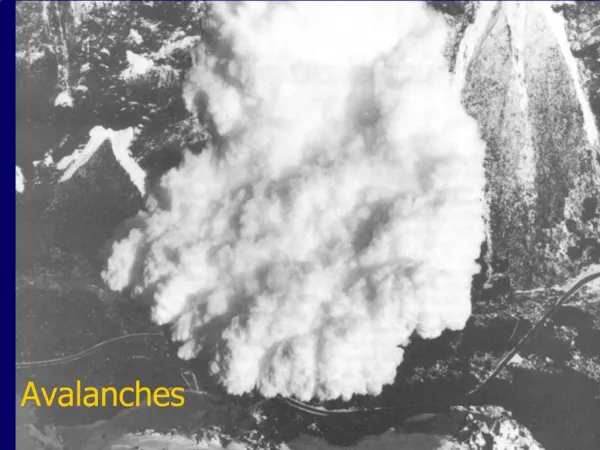
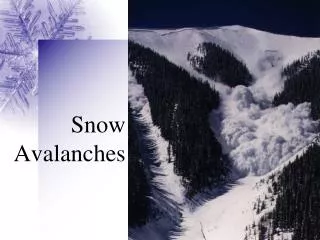
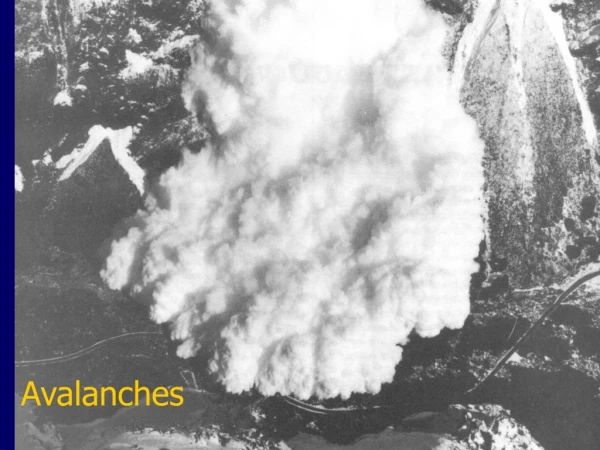
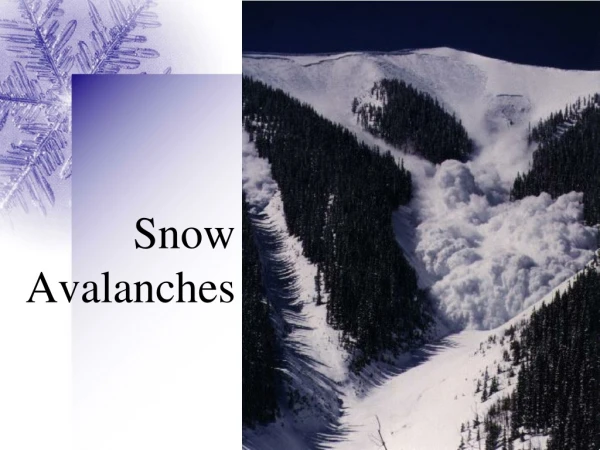
what is an avalanche? • a falling mass of snow and/or ice • a mass-wasting process • analogous to debris flows or mudslides • a natural hazard - threat to life and property • an expression of earth system complexity
why do we care? • recreation • ski areas • backcountry • transportation • highways • railroads • communities/structures • avalanches are cool Westwide Avalanche Network
outline • overview of: • avalanche interests • accident statistics • avalanche formation factors • current research
ski area avalanche management • snow compaction • skier traffic • boot packing • intentional avalanche release • explosives • ski cutting • cornice management Westwide Avalanche Network
backcountry recreation • no active control • who gets caught – trends in avalanche statistics • avalanche accidents • forecasting • education • be your own snow expert Westwide Avalanche Network
recent trends • recent explosion in backcountry use • technological advances • ski gear • snowmobile power and design • “Extreme” hype • availability of avalanche education Gallatin National Forest Avalanche Center
avalanches and transportation • highways and railways • control and reduction • high cost of link closure • potential for disaster
transportation • active control WSDOT www.gaz-ex.com
passive control www.eng.ucalgary.ca WSDOT www.eng.ucalgary.ca
avalanche hazard to communities • primarily a European issue • higher alpine population density • resort development in US
types of avalanches • loose snow (point release) • slab • soft slab • hard slab • distinction based on snow cohesiveness • can be wet or dry snow
Loose Snow Avalanche • Tear drop shape • Unconsolidated • Wet or Dry • Often only surface snow • Point release • Sluff • Easier to predict
slab avalanche terminology Starting zone Track Runout zone
slab avalancheterminology • crown face • bed surface • flanks • stauchwall Class demonstration, stupid!
avalanche formation factors • terrain • weather • snowpack • humans • good news: the snowpack is stable the majority of the time
terrain • Is the terrain capable of producing an avalanche?
terrain • factors to consider: • slope angle • slope size and consequences • slope shape • vegetation and trees • runout • aspect with respect to wind • elevation
Is this avalanche terrain? terrain
slope angle 60° • NOTE: referring to the steepest part of the slope 45° 30° 25° 0°
slope shape • convexities and concavities zone of compression zone of tension Gravity’s influence snow slab
Trigger Points ROCK TREE CLIFF CONVEX CONCAVE PILLOW
vegetation and trees • indicators of avalanche activity • tree “flagging” • secondary growth • trees can anchor snow
vegetation and trees • ground cover affects: • effective snow depth • heat transfer ~ snow metamorphism in basal layers
vegetation change • implications of • climate change • timber cutting • creation of starting zones • forest fires • removes ground cover, thins trees • large avalanche events
weather • Is the weather affecting the snow stability? • Precipitation (snow or rain) • Wind • Temperature
precipitation • addition of mass to the snowpack • rate of addition is important • stress vs. strength strength stress θ compression gravity θ
wind • snow redistribution • change in snow density • cornices
Aspect In Relation To Wind WIND WIND Lee Loaded Cross Loaded