
SlideServe
Menu
Préférences
© SlideServe · v2026

Superconducting vortex avalanches

brynne-vang avatar
21 diapositives · 545 Views · Nov 03, 2014

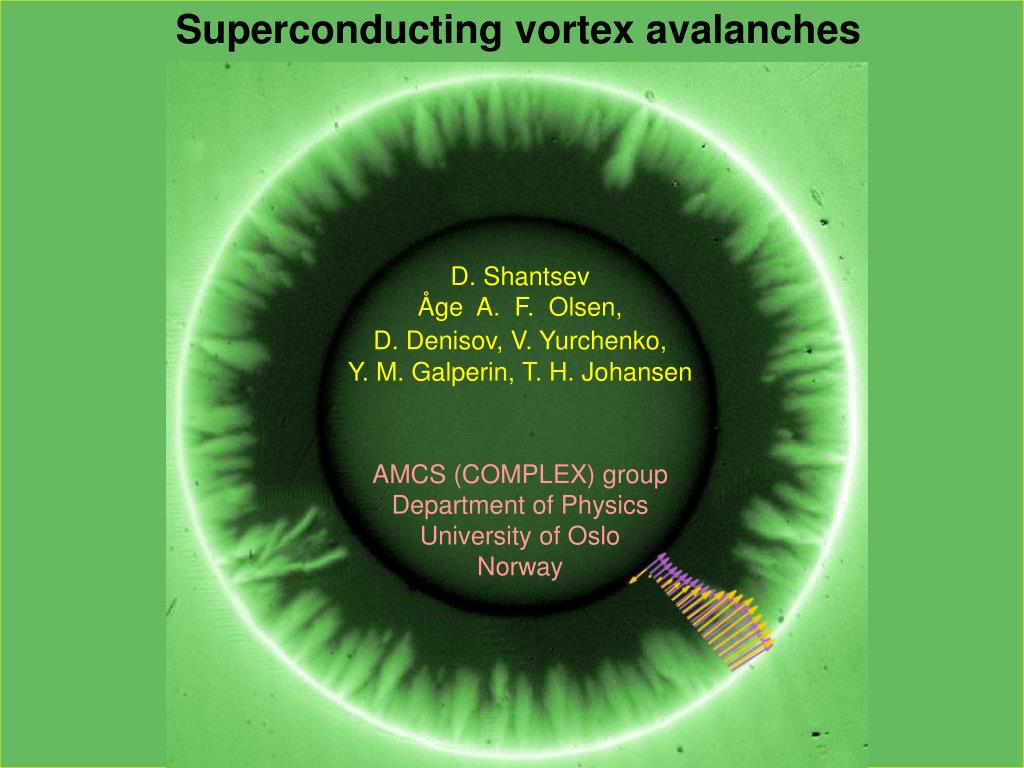
Superconducting vortex avalanches. D. Shantsev Åge A. F. Olsen, D. Denisov, V. Yurchenko, Y. M. Galperin, T. H. Johansen AMCS (COMPLEX) group Department of Physics University of Oslo Norway. Vortex lattice A. Abrikosov (published 1957). H c2. Normal state. Mixed state
Superconducting vortex avalanches - slide 1
01 / 21Superconducting vortex avalanches
1 / 17

Télécharger la présentation

Superconducting vortex avalanches
Une image / un lien ci-dessous est fourni (tel quel) pour télécharger la présentation

Politique de téléchargement : le contenu du site vous est fourni TEL QUEL pour votre information et votre usage personnel ; il ne peut être vendu, concédé sous licence ni partagé sur d’autres sites sans l’accord de son auteur.Le contenu vous est fourni TEL QUEL, pour votre information et votre usage personnel uniquement. Téléchargez la présentation en cliquant sur ce lien. Lors du téléchargement, si vous ne parvenez pas à télécharger une présentation, l’éditeur a peut-être supprimé le fichier de son serveur.Pendant le téléchargement, si vous ne parvenez pas à obtenir une présentation, le fichier a peut-être été supprimé par l’éditeur.

F I N

Plus de contenu associé

Transcription de la présentation
  1. Superconducting vortex avalanches D. Shantsev Åge A. F. Olsen, D. Denisov, V. Yurchenko, Y. M. Galperin, T. H. Johansen AMCS (COMPLEX) group Department of Physics University of Oslo Norway

  2. Vortex lattice • A. Abrikosov • (published 1957) Hc2 Normal state Mixed state (vortex matter) Type II 2003 Hc1 Meissner state Temperature Tc Vortices in Superconductors

  3. Vortices are driven by Lorentz force and their motion creates electric field E ~ dB/dt Lorentz force F = j F0 Vortices get pinned by tiny defects and start moving only ifLorentz force > Pinning force Ba Lorentzforce current J • Resistance is zero only due to pinning • Stronger pinning => larger currents pinningforce

  4. Critical state • Vortices : • driven inside due to applied field • get pinned by tiny inhomogeneities • => Metastable critical state Picture: R.Wijngarden Avalanches ?

  5. Trapped field magnets High-current cables Jc Record trapped field: 17 Tesla ~100 times better than Cu wire “Applied” Motivation to study vortex avalanches The slope of the vortex pile - the critical current density Jc – is the key parameter for many applications of superconductors

  6. Self-organized criticality for vortex avalanches in Nb E. Altshuler et al. Phys. Rev. B 70, 140505 (2004) Power-law Number of avalanches Avalanche size (number of vortices)

  7. Statistics of vortex avalanches Reference Geometry Material Sensor Avalanche type Avalanche distribution Heiden & Rochlin PRL (1968) Hollow cylinder Pb-In Coil Off the edge Exponential Field et al PRL (1995) Hollow cylinder Nb-Ti Coil Off the edge Power law (slow ramps) Zieve et al PRB (1996) Planar YBCO crystal 1 Hall probe Internal Peaked Nowak et al PRB (1997) Ring Nb film 2 Hall probes Off the edge & internal Peaked or Power law (dep. on T) T-effect ? Aegerter PRE (1998) Planar BSCCO crystal SQUID Off the edge Exp or Power law (dep. on T & t) Behnia et al PRB (2000) Planar Nb film Hall probe arrang. Internal Peaked or Power Law (dep. on H & T) Table from Altshuler&Johansen, RMP 2004

  8. Local Temperature Increases It is easier for vortices to overcome pinning barriers +kT Vortices move faster E ~ dB/dt Vortex motion dissipates energy, J*E velocity positive feedback current

  9. Thermal avalanches Shape of dendritic avalanches Size of small avalanches THEORY EXPERIMENT Dendrites Phys. Rev. B 70, 224502 (2004) Phys. Rev. B 72, 024541 (2005) Phys. Rev. B 73, 014512 (2006) Threshold fields for dendritic avalanches Anistropic dendritic avalanches Phys. Rev. Lett. 97, 077002 (2006) Phys. Rev. Lett. 98, 117001 (2006) Phys. Rev. ? (200?)

  10. How to determine T without measuring T ? MgB2 ring

  11. Some avalanches perforate the ring: they connect the outer and inner edges and can bring FLUX into the hole

  12. Every step: a perforating avalanche Flux in the hole Applied field

  13. Stage 2: Heated resistive channel current DF • Decrease of current • Injection of flux into the hole Stage 1: Propagation of the tip current Speed: ~100 km/s (P. Leiderer) Time: ~ 10 ns

  14. Temperature evolution in the heated channel: T t I L = 4 nH 100 K ~2.5Tc

  15. WRONG I I = 0 Perforation reduces the total current in the ring by just ~15%

  16. Distribution of current density in the ring perforation-induced change inner radius outer radius

  17. Conclusions • Types of vortex avalanches: • non-thermal (power-law size distribution): SOC • thermal (peaked size distribution): their size, topology and threshold fields are in agreement with theory • Rings: two-stage avalanches • tip crosses the ring • short-lived heated channel transferring flux into the hole • Maximal T during avalanche: • 100 K in MgB2 ring with Tc=40 K Phys. Rev. B 74, 064506 (2006) Phys. Rev. B ? (cond-mat/0705.0997)

  18. magnetic field lines Vortex latticeseen at the superconductor surface superconductor 0 flux quantum 50 nm (at 1 Tesla) vortex core x ~ 10 nm J 2003 Nobel prize to Alexei Abrikosov for prediction of Vortices B(r) l Superconductor has “internal” magnetic nanostructure

  19. r1 r0 Φ J