Learn about avalanches, their triggers, sizes, and impact. Explore avalanche zones, structural dynamics, initiation, and mitigation methods. Discover how slope angles, snow types, and internal structures influence avalanche behavior.
01 / 59Avalanches: Causes, Consequences, and Prevention
1 / 17
Télécharger la présentation
Avalanches: Causes, Consequences, and Prevention
Une image / un lien ci-dessous est fourni (tel quel) pour télécharger la présentation
Politique de téléchargement : le contenu du site vous est fourni TEL QUEL pour votre information et votre usage personnel ; il ne peut être vendu, concédé sous licence ni partagé sur d’autres sites sans l’accord de son auteur.Le contenu vous est fourni TEL QUEL, pour votre information et votre usage personnel uniquement.Téléchargez la présentation en cliquant sur ce lien.Lors du téléchargement, si vous ne parvenez pas à télécharger une présentation, l’éditeur a peut-être supprimé le fichier de son serveur.Pendant le téléchargement, si vous ne parvenez pas à obtenir une présentation, le fichier a peut-être été supprimé par l’éditeur.
What are avalanches? • They are rapid downslope movements of snow, ice, rock, or soil. • They can be channelized or unconfined • may travel as coherent block or disaggregate into small particules
What Drives Avalanches? -The driving force is Gravity -Gravity is a force that attracts objects toward the Earth Fg=mg Fg=Force of gravity m=mass g=gravitational constante
Avalanches have severe consequences Direct effects: • impact • Burial • Most fatalities were people killed while building railways (canadian Pacific Railway, in 1886) • The 8 km Connaught channel was constructed beneath the mountains to by pass some of the most dangerous avalanche paths.
Avalanches have severe consequences -Traffic delays and economic losses (For 100 hours each winter, the Trans Canadian Highway in Rogers Pass, British Columbia is closed because of avalanches). -Property damage -Forests damage: uprooting, breaking trees
Avalanche Triggering • Naturally: after snow storms or normal daytime heating upper part of the snowpack. • The person’s weight increases the shearing force in the weak layer triggering failure • Intentionally with explosives, as part of avalanche-control programs
What is a cornice? A cornice is an overhanging edge of snow on a ridge or the crest of a mountain A cornice of snow about to fall. Cracks in the snow are visible in area (1). Area (3) fell soon after this picture was taken, leaving area (2) as the new edge. Wikipidia
Avalanche zones • a) Starting zone: where the snow pack fails • b) Avalanche track: along which the avalanche accelerates and achieves its highest velocity • c) Runout area: where the avalanche decelerates and snow is deposited
Avalanche zones The three parts of an avalanche path: starting zone, track, and runout zone. (Photograph courtesy of Betsy Armstrong; Source: NSIDC)
a.Starting zone Gravity and slope gradient • *shear strength (stay force) • internal resistance to movement or force of cohesion and friction • *shear stress (Go force) • force causing movement parallel to slope • increases with slope angle -At a certain point, gs(go) exceeds the shear strength(stay), and failure of the mass occurs
Angle of Repose -When the go force is equal the stay force the balance is reached and the angle is 45 degrees. -The angle of repose is at 40 degrees and is the angle beyond which material will start to move down a slope.
When will a slope fail? Fs = Safety Factor Fs = (shear strength)/(shear stress)=Stay force/Go force shear strength (stay force) internal resistance to movement shear stress (Go force) force causing movement parallel to slope increases with slope angle If Fs is less than 1, then the slope is unstable and prone to failure
Slope Angle -Most avalanches (slabs) are released from slopes between 30 and 45 degrees -Slopes less than 25 degrees and steeper than 60 degrees have a very low avalanche risk. -Wet snow slides, can happen on slopes less than 25 degrees. They contain liquid water between the grains of snow.
Avalanche Initiation 1-Point release avalanches (loose snow) : initial failure of a small amount of snow. More snow is incorporated into the avalanche as it moves downslope. 2-Slab avalanche begins with fracturing of the snowpack along a weak layer at depth. Gravity causes the snowpack to move downslope with the top moving faster than the bottom.
b) Internal structure of the flow Density and solids concentration gradient The powder cloud is less dense than the flowing snow • 2 types of snow avalanche (a spectrum exists): • flow avalanches • airborne powder snow avalanches
Avalanche flow structure • Note the head, body, and tail of the flow • a lower dense portion which is highly hazardous and destructive • an overlying more dilute portion…also can be hazardous and destructive, since it is turbulent
Flow avalanches • Velocities up to 216 km/hr (60 m/s) • Flow heights 5-10 meters • Collisions of particles - granular flow • Initially tends to slide as a rigid body (similar to a landslide)… • …but rapidly breaks up into smaller particles and becomes a granular flow
Interior of the flow -There is a high-density core near the base of the flow -In this zone, particles collide, resulting in friction and producing heat -When the avalanche flow stops, freezing can occur, making the deposit very hard -sets like concrete High-density core
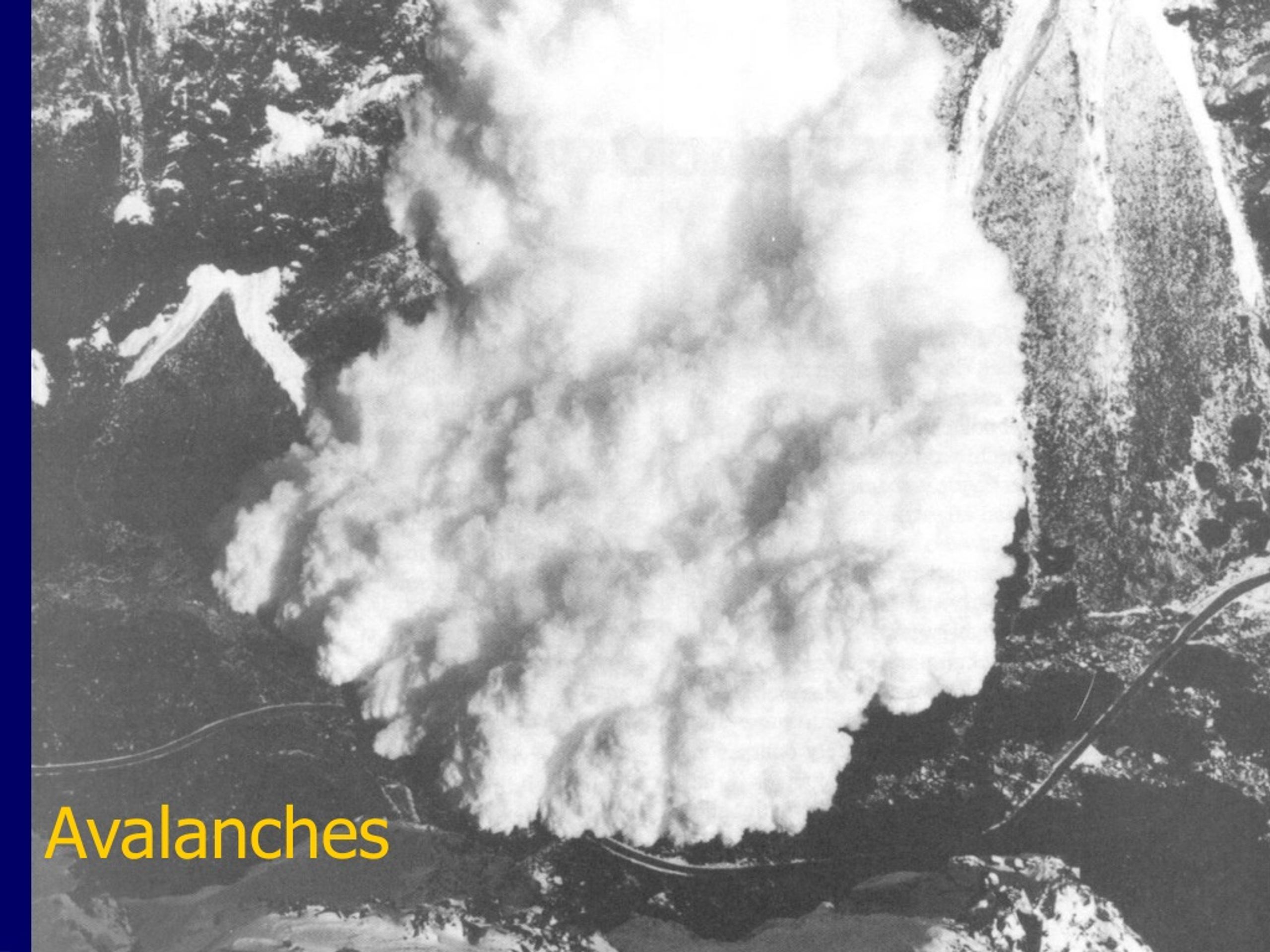
Mixed flow and powder avalanche Atvelocities above 35km/h flow avalanches generate a cloud of powdered snow. The powder cloud is much less dense than the flowing mass.
Airborne powder snow avalanches • Velocities can exceed 360 km/hr (100 m/s) • Flow thicknesses may exceed 100 meters • Essentially a highly dilute density current flowing down an incline: • partial entrainment of underlying snow by turbulent, erosive flow • dense core small or absent • powder avalanches may develop from flow avalanches, but the mechanisms are not well understood
c) Runout area • Powder snow avalanches flow around obstacles, while flow avalanches do not • When powder snow avalanches hit a barrier, the lower dense portion of the flow is stopped, while the more dilute cloud behaves like a fluid which can flow around or over the obstacle
Some Canadian statistics • Activity1959-7474-89 • Fatalities: recreational 33 97 • activities • Fatalities: buildings, 53 6 • roads, worksites
Mitigation • Avoid steep slopes, gullies • Close high-hazard areas to reduce risk and vulnerability • Set off explosive charges to artificially induce avalanches and remove the source material (unstable snow)
HAZARD MAPS, Alta, Utah:Avalanche Risk can be estimated by determining the distribution, frequency, and sizes of avalanches in given area. Avalanche frequency is described in terms of a recurrence interval Note lack of vegetation, which could help dissipate avalanches
Engineering works • Reforestation: • to stabilize slopes and snow • Highways: • locate to avoid avalanche tracks • use of defense structures: deflectors, mounds, benches with dams
Use of defense structures Starting zones defenses to support the snowpack and prevent large avalanges (famous in Europe)
Starting zone defenses Terracing in avalanche starting zones • To help reduce avalanches from forming: • use of terraces • use of supporting structures
Supporting structures Prevent large avalanges from starting, they are very expensive and used only where people and property are at risk.
Details of supporting structures Only practical for protecting inhabited structures, busy roads and critical infrastructure (not commonly used in North America)