
Industrialization
E N D
Presentation Transcript
Industrialization Technology and Greed at Its Best 1, 4, 6
U.S. Economy • Consolidation of business into trusts • Technological innovations • Growing concentration of wealth • Control of industries by bankers
Attitudes of Businesses • Social Darwinism • allowed men of wealth justify the economic inequality that favored them over the nation's poor • Supported no regulation of business • Herbert Spencer
Attitudes of Businesses • Government should not Protect workers from unfair labor practices (laissez faire) • Standard Oil corporate structure –horizontal integration-creating a monopoly by combining all competing companies into a single area of business.
Big Business Practices • Horizontal Integration: Creating a monopoly in one area of the business cycle in order to control an entire industry. • John D. Rockefeller’s Standard Oil • Rockefeller eventually controlled 90% of the oil refineries in the United States • He had a monopoly on the oil supply and could drive his competition out of business Oil wells Standard Oil refineries Gas stations
Andrew Carnegie’s Gospel of Wealth • People with wealth should help society • Each man had a duty to become rich • Use wealth for the good of society • Wealth was God’s reward for a life of virtue and hard work • Support educational, health, and religious institutions
Andrew Carnegie’s Vertical Integration • Vertical Integration: controlling all aspects of business from the gathering of raw materials to the final distribution of a product
Big Business Practices • Vertical Integration: controlling all parts of the business cycle from finding raw materials to the final delivery of a product • Carnegie Steel is an example Coal Mine Steel Factory Railroad to ship steel Carnegie Steel Carnegie Steel became the biggest steel company in America
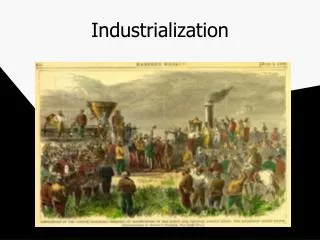
Railroad Expansion • Transcontinental Railroad 1869 • Union Pacific meets Central Pacific at Promontory Point, Utah • In General, Railroad lines were overcapitalized ( more money invested than what was needed) • Significance of the Railroad network: • Spurred Industrialization
Railroad Expansion • The nation became united physically • Created a nationwide market for mining, ranching and agriculture • Facilitated immigration • Advertisements of free transportation to western fars • Chinese and Irish immigrant work on the rail lines.
Railroads-corruption Cornelius Vanderbilt set up a RR Trust • formed pools in order to fix prices and divide business for greater profit • Rebates and kickbacks
Laws passed to regulate RR Interstate Commerce Act • RR’s must publish rates and charge the same amount all year long.
Problems in the Workforce • Workers had been mistreated for years • 10-12 hours per day • Dangerous jobs • Child labor • Very little pay
Labor-Unhappiness on the job Labor Unions began to appear in the mid 1800’s • Knights of Labor (1869) – Wanted eight-hour working day. Allowed all to join—skilled/unskilled, men/women, black/white • The labor strike was the number one tool of the union.
Labor • major strikes were defeated by business and government • RR strike of 1877: troops called in by Hayes • Homestead Strike 1892: Strike at Carnegie Steel was broken by troops • Pullman Strike 1894: American Railway Union led by Eugene V. Debs strikes. 2,000 troops sent by Pres Cleveland. Debs is jailed.
Labor • The Haymarket bombing Chicago 1886 • aroused public opposition against labor, • contributed to the decline of the Knights of Labor • caused an increase in the membership of the AFL
THE NEW SOUTH 1877-1900 • Influential Southerners like Henry W. Grady, encouraged Southern industrialism during this time. • James Buchanan Duke: American Tobacco Co. produced machine rolled cigarettes. • Offering Cheap labor, Textile mills began operation in the South
THE NEW SOUTH: Obstacles to success The industrial North’s control of the Railroads kept Southern industry down. • Rates for shipping to the South cheaper than shipping North. • Steel from the South was often charged an additional fee. NET RESULT: Some industrial progress was made but the Southern economy continued to be dominated by sharecropping, racism and a low standard of living.