PHENOLS
This document provides an in-depth examination of various solid and crystalline phenolic compounds, characterized by their flaky, fine powder forms with shades ranging from white to gray and buff. The compounds exhibit distinct phenolic odors, are highly flammable, and are soluble in water. It details the chemical reactions involved in synthesizing diazonium salts and azo dyes, including their visual changes and stability conditions. Applications in fluorescence and dye formation through specific mixture ratios are also discussed, emphasizing the role of phenolic compounds in chemical reactions and their indicators.
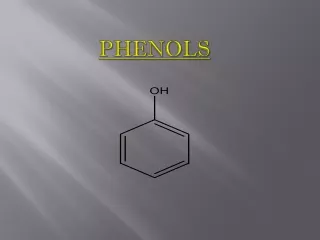

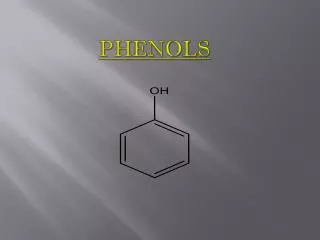
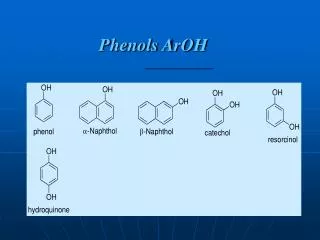
PHENOLS
E N D
Presentation Transcript
Solid, crystalline. Solid, flaky. Solid, fine powder. White gray Buff Phenolic odor
All inflammable, luminous, smoky All melting All on change in odor All no residue All the compounds are aromatic Solubility: All soluble in H2O L.p.:No change Comment All the compounds are neutral
No reaction Penolic odor Not done Penolic odor No reaction for all No reaction for all Very diluted phenols + 1– 3 drops FeCl3 Green color which rapidly darkens violet – blue color Not done for all No reaction for all No reaction for all
1 drop aniline (red color) + dil.HCl (until dissolve) + NaNO2 (sod. Nitrite solution) until faint pale yellow color (1) {Diazonium salt formed} It is unstable because that we must put it in ice, without ice it will decompose few phenol + 10% NaOH (until phenol dissolved) (2) Add (1) on (2) gradually ((Azo – dye formation)) Orange – red dye Azo – dye form {Dark purple or brown dye}
Phthalein test Phenol + phthalic anhydride + 4 drops Conc. H2SO4 cool Dry test tubepour in beaker containing fussion 20 ml 10% NaOH Pink color Due to phenol phthaline ((indicator)) Green fluorescence H2O Fluorescence Bluish Brown color Due to Alizarin indicator