
SlideServe
Menu
Préférences
© SlideServe · v2026

Triangulation

ltowe avatar
6 diapositives · 1.6K Views · Jan 03, 2020

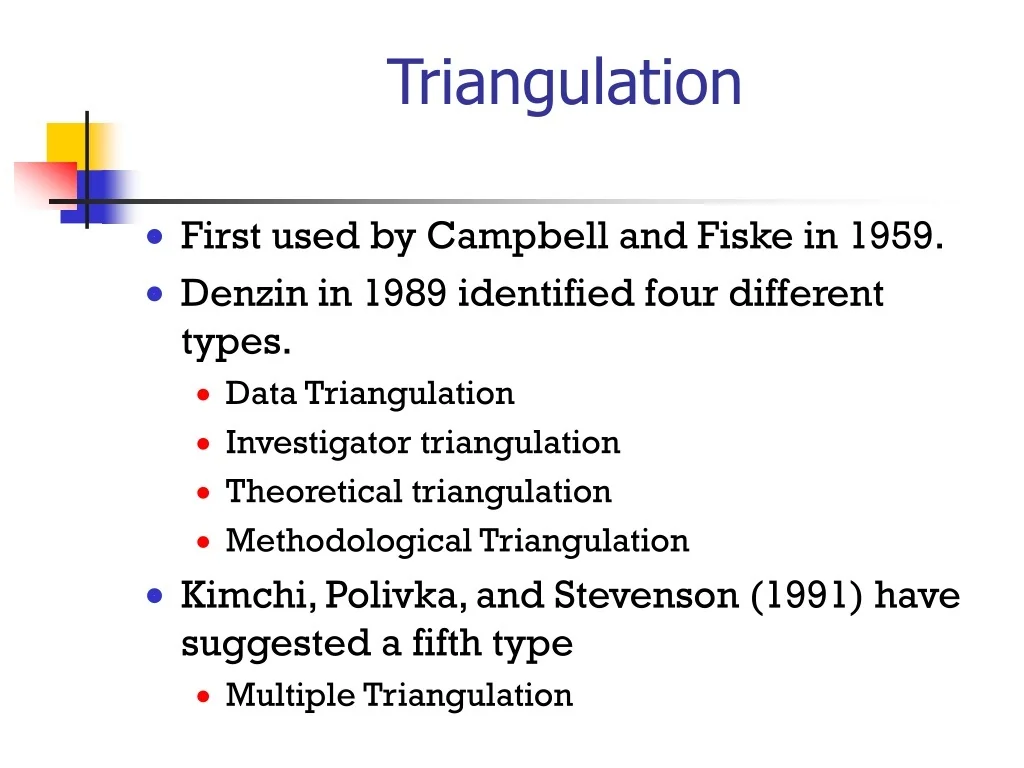
Triangulation. First used by Campbell and Fiske in 1959. Denzin in 1989 identified four different types. Data Triangulation Investigator triangulation Theoretical triangulation Methodological Triangulation Kimchi, Polivka, and Stevenson (1991) have suggested a fifth type
Triangulation - slide 1
01 / 6Triangulation
1 / 17

Télécharger la présentation

Triangulation
Une image / un lien ci-dessous est fourni (tel quel) pour télécharger la présentation

Politique de téléchargement : le contenu du site vous est fourni TEL QUEL pour votre information et votre usage personnel ; il ne peut être vendu, concédé sous licence ni partagé sur d’autres sites sans l’accord de son auteur.Le contenu vous est fourni TEL QUEL, pour votre information et votre usage personnel uniquement. Téléchargez la présentation en cliquant sur ce lien. Lors du téléchargement, si vous ne parvenez pas à télécharger une présentation, l’éditeur a peut-être supprimé le fichier de son serveur.Pendant le téléchargement, si vous ne parvenez pas à obtenir une présentation, le fichier a peut-être été supprimé par l’éditeur.

F I N

Plus de contenu associé

Transcription de la présentation
  1. Triangulation • First used by Campbell and Fiske in 1959. • Denzin in 1989 identified four different types. • Data Triangulation • Investigator triangulation • Theoretical triangulation • Methodological Triangulation • Kimchi, Polivka, and Stevenson (1991) have suggested a fifth type • Multiple Triangulation

  2. Data Triangulation • Collection of data from multiple sources • Intent is to obtain diverse views of the same phenomenon. (Longitudinal is different and is looking for change) • Validate data by seeing if it occurs from different sources

  3. Investigator Triangulation • Two or more investigators with different research backgrounds examining the same phenomenon • Clarifies disciplinary bias • Adds to validity of data

  4. Theoretical Triangulation • Using all the theoretical interpretations that could conceivably be applied to a given area • Each view is critically examined for utility and power • Increased the confidence of the hypothesis • Can lead to even greater T. F. beliefs

  5. Methodological Triangulation • The use of two or more research methods in a single study • Design level • Data collection level • Two major types • Within-method (all are one philosophy) • Across-method (across philosophies)

  6. Pros and Cons of Triangulation • Very trendy in the 90’s • Can be used with smaller N • Combined methods may just be the rise of a new method • There are philosophical risks • Complex designs and therefore complex analysis