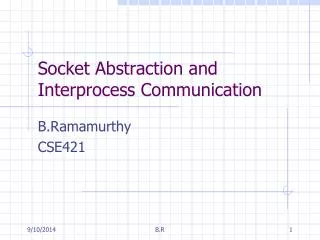
Socket Swapping for efficient distributed communication between migrating processes
Socket Swapping for efficient distributed communication between migrating processes. MS Final Defense Praveen Ramanan 12 th Dec 2002. Introduction. What is Process Migration? The mechanism of transferring a process between two machines during its execution What is Socket Migration?

Socket Swapping for efficient distributed communication between migrating processes
E N D
Presentation Transcript
Socket Swapping for efficient distributed communication between migrating processes MS Final Defense Praveen Ramanan 12th Dec 2002
Introduction • What is Process Migration? The mechanism of transferring a process between two machines during its execution • What is Socket Migration? The mechanism of transferring one end of a live connection from one host to another without loss or interruption to the packet flow
Need for Socket Migration • Lack of Network Socket Migration at the Operating System Level • MOSIX, its importance with socket migration
MOSIX and its characteristics • Software that can transform a Linux cluster of x86 based workstations and servers to run almost like an SMP • Has the ability to distribute and redistribute the processes among the nodes
Process Migration in MOSIX User-level User-level Remote Local process Link Layer Link Layer Deputy Kernel Kernel A local process and a migrated process
Processes in machine A and B Communicate through Sockets Process migrates to Machine C Process then communicates through C library Communication is re-established between the processes Solution: Kernel Socket Swapping A B SocketSwap is called After communication C
Technologies/Tools Used • User Mode Linux (UML) • Aglets • JNI (Java Native Interface)
Sockets • OS interface that allow communication between two different processes on same or different machines • Behaves much like a low-level file descriptor • Identified by a host.port pair
System calls • Entry points through which an active process obtain services from the kernel • Distinction between user mode and kernel mode • Context switch done by generating a software interrupt
Socket related System Calls • Socket() • Bind() • Listen() • Connect() • Accept() • Read() and Write() • Close()
Socket Strucuture struct socket { socket_state state; unsigned long flags; struct proto_ops *ops; struct inode *inode; struct fasync_list *fasync_list; struct file *file; struct sock *sk; wait_queue_head_t wait; short type; unsigned char passcred; }
Writing the System Call • Implemented in User Mode Linux, a safe secure way of running linux versions and linux processes
Why UML? • UML is a virtual machine which runs linux inside linux • Debugging and testing becomes easy • Protects the main linux machine from abnormal crashes
Features of UML • It has a fully functional kernel • It has hardware support • It has access to host file system • It is completely configurable, allowing its memory, available devices to be specified
Mobile agents and aglets • Have unique ability to transport themselves from one system to another • Aglets are java objects that can move from one host to the other • Aglets takes the program code as well as data during its movement
Testing the System Call through aglets and JNI • Aglets are made to communicate through a C library (C library uses sockets) through JNI • During communication, aglets are made to move from one machine to another • System call is called and the socket is swapped • The communication of the moved aglet is then established with the swapped socket
1. Aglets A and B are communicating within the same machine thru Send and Recv Fns of C library API 1 5 2.Aglet B moves from one machine to another. 2 3.AgletB Contacts the HaveMoved() of the local C library 4 4.Local C library communicates with C library of the remote machine. 3 5.system call swaps the socket
6.New Communication is established between the processes after socket swap. 6
Acknowledgements • Dr Daniel Andresen • Dr Gurdip Singh • Dr Mitchell Neilsen