Hybrid FEM-VOF Technique for Free Surface Flow Simulation
110 likes | 288 Vues
This work presents a novel hybrid approach combining Finite Element Method (FEM) and Volume of Fluid (VOF) techniques for simulating free surface flows. The proposed methodology effectively handles large surface deformations—such as merging and breaking—while ensuring an accurate representation of boundary conditions. Utilizing a three-stage iterative cycle for mesh deformation and a Newton-Raphson iterative procedure, this approach allows for simultaneous solving of field variables and boundary positions. The technique promises increased computational efficiency and versatility in various fluid dynamics applications.


Hybrid FEM-VOF Technique for Free Surface Flow Simulation
E N D
Presentation Transcript
FEM and Free Surface Flow • Three basic approaches: 1. Fixed mesh and free boundary is tracked 2. Deformed spatial mesh using a 3-stage iterative cycle • Stage 1: Assume shape of free boundary • Stage 2: BVP solved after discarding 1 BC on free boundary • Stage 3: Shape of boundary is updated using previously neglected BC • Cylce repeated until convergence is acheived 3. Deformed mesh and define nodes on free boundary • Nodes give extra degrees of freedom • Field variables and boundary position solved simultaneously using a Newton-Rapson interative procedure
FEM and Free Surfaces: New Approach • Combination of FEM and VOF technique • FEM solves for the field variables on a deforming boundary • VOF used to advect the boundary interface • Advantages: • Simulate Large Surface Deformations (i.e. Mergering and Breaking) • Accurate implementation of Boundary Conditions • Increases computational efficiency
FEM-VOF: Governing Equations • Governing Equations (non-dimensional form) • Continuity • Navier-Stokes (Momentum)
FEM-VOF: Boundary Conditions • BCs are given by: • Surface Traction is related to Radii of Curvatures • Radius of Curvature is defined as:
FEM-VOF: Formulation • Two restictions 1. Solution in terms of primitive variables based on linear quadrilateral elements 2. Model must handle: pressure, velocity, velcoity gradient and stress boundary conditions directly • Penalty function • Apply Galerkin Method to Momentum equations
FEM-VOF: Mesh Generation • Master element: Isoparametric linear quadrilateral element • 9 possible cases regarding intersection points
FEM-VOF: Surface Advection • Once velocities obtained interface is advected using FLAIR • Velocities at nodes NOT adequate for advection technique • Calculate “mean” velocity fom two node velocities • Axisymmetric r-z plane mapped to master element in plane
FEM-VOF: Moving Nodes • Governing Equations for Moving Nodes: • Motion only in R-direction • Extra terms will modify finite element formulation
FEM-VOF: Solution Procedure • 1: Specify inital surface geometry and velocities • 2: Determine inital f-field based on geometry • 3: Using FLAIR reconstruct surface interface • 4: Mesh domain • 5: Solve for nodal velocities using the Navier-Stokes Eqs. • 6: Transform nodal velocities to cell face velocities • 7: Determine new f-field by advecting old f-field using FLAIR • 8: Reconstruct new surface interface • 9: Increment time and repeat 4-8 until done
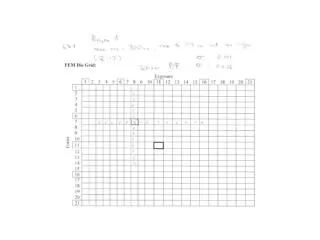
0 0 0 0 0 0 0 0 0 0 .98 .86 .59 .15 0 1 1 1 .91 0 .91 1 1 1 1 0 0 0 0 0 .15 0 0 0 .25 1 .89 .67 .16 0 1 1 1 .95 .19 .55 1 1 1 1 FEM-VOF: Algorithm Steps
Conclusion • Volume of Fluid (VOF) Methods: • Reconstructs interface surfaces • Able to handle large surface deformation • Easy implementation • Many forms exist • Hybrid FEM-VOF technique for Free Surface Flows • Combination eliminates short-comings of each method • Handles BCs accurately • Handles Large Surface Deformation (i.e. Merging & Breakup) • Accurate and versatile