The Digestive System
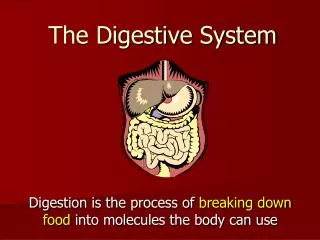
The digestive system is a complex network responsible for processing food in four main stages: ingestion, digestion, absorption, and elimination. Ingestion begins when food enters the mouth, where it's physically broken down by teeth and saliva. Digestion continues as the food travels down the esophagus to the stomach, where muscular contractions and digestive acids further break it down. In the small intestine, nutrients are absorbed into the bloodstream, providing energy to cells. Lastly, undigested materials are processed in the large intestine and eliminated as feces.

The Digestive System
E N D
Presentation Transcript
The Digestive System SNC 2P1
Processes of the Digestive System Ingestion: Food is taken into the body Digestion: Food is broken down into nutrients. • Physically- dissolving and breaking into smaller bits • Chemically- broken down through chemical reactions Absorption: nutrients diffuse/move into the blood. Energy from these nutrients is then given to the cells through cellular respiration Elimination: Solid waste then passes out of the system.
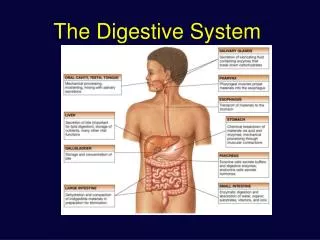
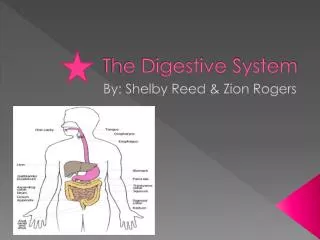
Ingestion happens as food enters mouth. Digestion begins with chewing as the teeth, tongue and saliva break down food. The esophagus pushes food down into the stomach, through muscular contractions. These contractions push the food all the way through the digestive system. Stomach muscles contract to mix the food. Stomach acids and chemicals break down the food. Digestion continues in the small intestine. Nutrients are absorbed into the bloodstream. Undigested food moves into the large intestine, where water and nutrients are reabsorbed. Undigested material is called feces and is passed out of the body.