Endocrine System
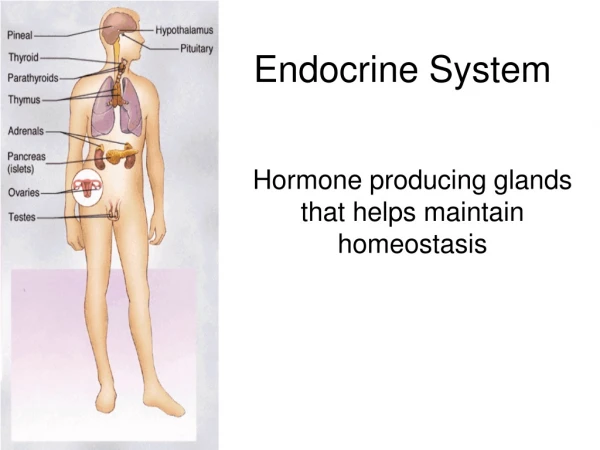
The endocrine system plays a critical role in synthesizing hormones and releasing them into the body, acting as chemical messengers that regulate essential functions. It maintains homeostasis, ensuring stable internal conditions. An imbalance in hormone levels can lead to adverse effects. The system operates on negative feedback mechanisms, where glands regulate hormone production to prevent excess. For instance, the hypothalamus and pituitary glands work together to control thyroid hormone levels through secretion modulation. Understanding these processes is vital for health, particularly concerning conditions like diabetes.

Endocrine System
E N D
Presentation Transcript
Endocrine System Alex Wiemann
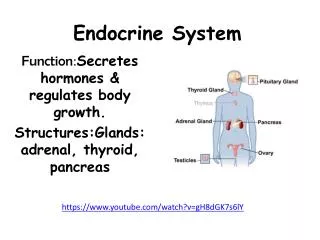
Function of the Endocrine System • The endocrine system synthesizes hormones and releases them into the body. • Hormones act as chemical messengers that help regulate and maintain various body functions.
Homeostasis • Homeostasis is the regulation of the internal environment of the body. • The endocrine system maintains homeostasis. If hormones levels were to become unbalanced, it would have detrimental effects on the body.
Negative Feedback Mechanisms • Negative feedback is when the glands within the endocrine system that stimulate the release of a hormone from another gland are eventually shut off so that too much hormone is not produced. • One example of a negative feedback mechanism is when the hypothalamus secretes TRH. This causes the pituitary to release TSH, which makes the thyroid gland secrete the thyroid hormone. When the body has enough thyroid hormone in the blood, the hormone causes a decrease in secretion of TRH and TSH by the hypothalamus and pituitary.
Sources • http://www.pennmedicine.org/health_info/body_guide/reftext/html/endo_sys_fin.html • http://www.nativeremedies.com/articles/endocrine-system-and-homeostasis.html • http://www.hormone.org/Endo101/page3.cfm • http://www.cushings-help.com/the_body.htm • http://neurosurgery.ucla.edu/body.cfm?id=432 • http://www.pyroenergen.com/articles08/thyroid-gland-hormones.htm • http://www.hormone.org/Endo101/page2.cfm • http://www.diffen.com/difference/Type_1_Diabetes_vs_Type_2_Diabetes