Creating Virtual Research Environments: A Comprehensive Guide
This tutorial outlines the process of creating Virtual Research Environments (VREs) using gCube and related technologies developed by D4Science. It covers key topics including the definition of VREs, underlying technologies like gCore, gHN, and gLite, and the roles of users in a Virtual Organization. The tutorial provides a step-by-step approach for setting up VRE infrastructure, managing resources, and user communities. By the end of the session, participants should have a clear understanding of how to initiate their own VRE and collaborate effectively in distributed environments.

Creating Virtual Research Environments: A Comprehensive Guide
E N D
Presentation Transcript
Creating a VRE RCDL 2008 10 October 2007 Dubna (Russia) Pedro Andrade CERN European Organization for Nuclear Research www.d4science.eu
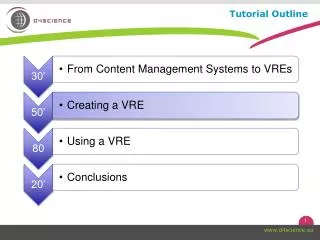
Session Outline • Introduction • Technology • gCube, gCore, gHN, gLite • Setting Up VREs • Interfaces & Roles • Infrastructure, VO, and VRE set-up • Effort & How to Start • Conclusions Creating a VRE
Introduction Creating a VRE
Introduction CREATING A VRE Not correct !!! CREATING VREs VREs are dynamic working environments Multiple VREs are created for different purposes Creating a VRE
Introduction • One VRE is a time-defined distributed environment to satisfy concrete collaboration needs of distributed user communities • VRE users are organized in Virtual Organizations • VRE resources are organized in Infrastructures Creating a VRE
Infrastructure A D4Science infrastructure is composed by: Creating a VRE
Infrastructure Site C Site A Site B Creating a VRE
Infrastructure VRE VO Infrastructure Creating a VRE
Technology Creating a VRE
gCube • gCube is the system developed by D4Science to create and maintain Virtual Research Environments. • gCube is composed by: • Infrastructure Enabling Services • Information Retrieval Services • Information Organization Services • Presentation Services • gCube components can be: Services, Libraries, and Portlets Creating a VRE
gCore • gCore is a framework developed by D4Science to reduce the complexity of designing and implementing gCube services. • gCore is composed by: • Framework: An application framework to consolidate and develop existing/new gCube services • Container: A self-contained software container distributed to facilitate the deployment of gCube services. Based on Java WS-Core (GT4). Creating a VRE
gHN • The minimum environment for any gCube node of the infrastructure is the gCube Hosting Node (gHN) • The gHN is composed by: • gCore Container • gCore Framework • gCube Infrastructure Enabling Services (partial) Creating a VRE
gHN • The gCube Hosting Node main functionality is: • Is the runtime container of gCube services • Provides access to local hardware resources, • Storage systems, instruments, CPU cycles • Grants lifetime management • Mediates service2service interactions • route requests to target service • enforce security and scope policies Creating a VRE
gLite • Computational intensive tasks are executed in EGEE nodes running the gLite middleware. • EGEE is one the largest grid infrastructure worldwide. It is composed by more than 260 sites (85k CPUs) • Several gCube services were designed to interface withthe gLite middleware. These interfaces give access to the EGEE infrastructure and consequently increase significantly the computing capabilities of any gCube-based infrastructure. Creating a VRE
Example gLite gHN gHN gLite gHN Infrastructure Creating a VRE
Setting Up VREs Creating a VRE
Overview Creating a VRE
Interfaces • From the “system administrator” perspective the creation of one gCube-based infrastructure, VO, VRE is done exploiting two main types of interfaces • Command Line Interface (CLI) • Used for the installation of gHNs • Portal • gCube portal is based on portlets technology (JSR168) • gCube portal runs on GridSphere • Used for the creation and management of VOs and VREs Creating a VRE
Roles VRE Designer Resource Owner Infrastructure Admin VO Admin VRE Admin Creating a VRE
Infrastructure Set-up • Install gHN nodes • Deploy Enabling Services • Information System • Software Repository • Populate the SR • Install Portal Infrastructure Admin gHN Portal gHN IS/SR Creating a VRE
VO Set-up • Install gHN nodes • Install gLite nodes • Prepare Collections • Prepare Applications • Register Resources Resource Owner DataB gLite DataA gHN MGVI gHN gHN Portal gHN IS/SR Creating a VRE
VO Set-up • Approves resources • gHNs • Data Collections • Manages users VO Admin DataB gLite DataA gHN MGVI gHN gHN Portal gHN IS/SR Creating a VRE
VRE Set-up • Defines a new VRE • Name • Time Period • Functionalities • Data Collections • Metadata Schema VRE Designer DataB gLite DataA gHN MGVI gHN gHN Portal gHN IS/SR Creating a VRE
VRE Set-up • Approves VRE • VRE Created • Services Deployed • Applies modifications • New Running Instances • New Layouts VRE Admin DataB gLite DataA gHN MGVI gHN Search gHN Portal gHN IS/SR Creating a VRE
Effort Creating a VRE
How to Start • How can a new user community have it’s own VO/VREs ? • By creating a new infrastructure • Different communities can run their own infrastructure • The new community provides all resources • By joining an existing infrastructure • D4Science runs a production infrastructure for its two user communities (Earth Monitoring and Fisheries Management) • The new community provides part of the resources Creating a VRE
How to Start Creating a VRE
How to Start • gCube software is available from • http://software.d4science.research-infrastructures.eu/ • gCube administrator guide: • https://technical.wiki.d4science.research-infrastructures.eu/documentation/index.php/Administrator%27s_Guide • gCube user guide: • https://technical.wiki.d4science.research-infrastructures.eu/documentation/index.php/User%27s_Guide Creating a VRE
Conclusions • A VRE brings together different types of resources through a well defined cost-effective process • The creation of a VRE is a simple and easy: • A new VO can join one infrastructure in less then 1 day • A new VRE can be deployed in less then 2 hours • Many automatic deployment & configuration operations managed via the gCube Portal Creating a VRE
Thank You ! Questions ? Creating a VRE