Download
1 / 10
100 likes | 222 Vues
District heating in Sweden serves 9 million inhabitants, accounting for 50 TWh and 48% of the total heat market. Present in every community with over 10,000 residents, the sector is still growing, yielding a turnover of 2 billion euros in a competitive, non-regulated heat market. Key factors for its success include lower prices, existing infrastructure, and a shift towards renewable energy. Utilizing diverse energy sources—such as biomass, industrial waste heat, and geothermal energy—district heating continues to provide an economical and environmentally friendly solution for heating needs.

E N D
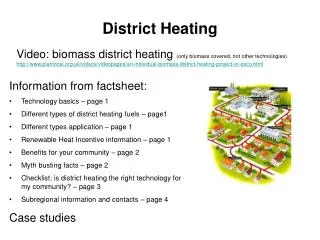
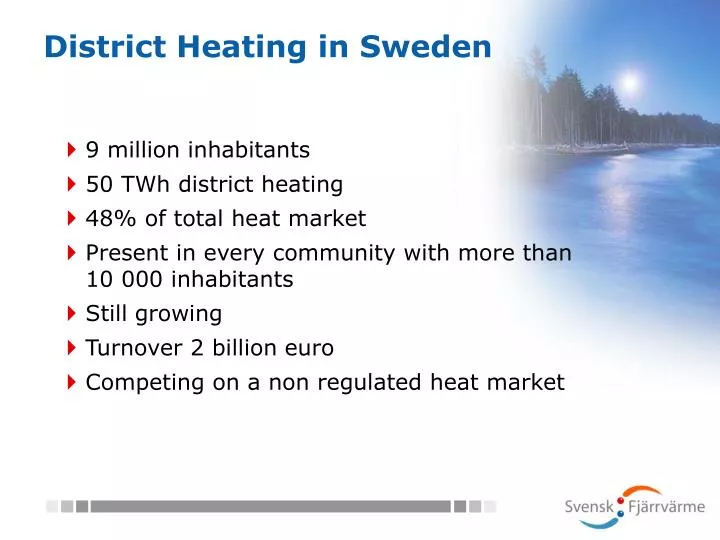
District Heating in Sweden • 9 million inhabitants • 50 TWh district heating • 48% of total heat market • Present in every community with more than 10 000 inhabitants • Still growing • Turnover 2 billion euro • Competing on a non regulated heat market
Market shares 25% 44% Other 93% 75% 56% District Heating 7% Public premises Family houses Blocks of flats Source: SCB
District Heating expansion Number of DH-Nets TWh/year 1980
From 1948 till today • The development of DH in Sweden has from the beginning been in a competitive environment. • However the establishment of the DH was done by the local governments, but fully financed by the customer. • Key factors were: • lower prices for DH compared to other heating sources, • existing heat distribution system in the houses • need for more fuel based power production (CHP).
The Opportunity for DH - Internalization of environmental impact • Energy taxes as a means of changing the use of energy from fossil fuel to renewable energy has been used • DH has been successful in implementing the idea • DH can provide cheaper energy to the customer by using cheaper energy sources
Geothermal energy Industrial Waste Heat Energy from Waste Bio Fuels Combined Heat and Power District Heating as we see it The Heat market
The idea of District Heating • The basic thinking of DH is to find cheap energy sources for the system, energy sources which can not be used without DH • industrial waste energy, • energy from waste, • energy from electricity production (CHP) • other difficult fuel.."
The Challenge – Energy EfficiencyFinal use of energy for heating in Domestic and Service sector 1970–2002
The district heating system RAD P L FC -will be successful only if it is a good economical alternative in the heat market Info&Komm-/01-03 (Gunnar Nilsson)