
SlideServe
Menu
Préférences
© SlideServe · v2026

Explore PHYLIP: Phylogenetic Analysis Tool

lundym avatar
6 diapositives · 112 Views · Jan 03, 2020

PHYLIP programs offer features for parsimony, distance matrix, and likelihood methods, including bootstrapping and consensus trees. They handle various data types such as molecular sequences, gene frequencies, and more. Compatible with protein and nucleotide sequences, other programs like TREEPUZZLE and phyml mimic its style. PHYLIP runs on all operating systems, with web interfaces available. Modular programs like PROTDIST and FITCH calculate distance matrices and trees efficiently. Users often rely on TreeView or NJplot for tree visualization. The Phylip Manual provides concise program descriptions for reference. Conveniently accessed through a command-line menu or via icons, PHYLIP enhances phylogenetic analysis with ease.
Explore PHYLIP: Phylogenetic Analysis Tool - slide 1
01 / 6Explore PHYLIP: Phylogenetic Analysis Tool
1 / 17

Télécharger la présentation

Explore PHYLIP: Phylogenetic Analysis Tool
Une image / un lien ci-dessous est fourni (tel quel) pour télécharger la présentation

Politique de téléchargement : le contenu du site vous est fourni TEL QUEL pour votre information et votre usage personnel ; il ne peut être vendu, concédé sous licence ni partagé sur d’autres sites sans l’accord de son auteur.Le contenu vous est fourni TEL QUEL, pour votre information et votre usage personnel uniquement. Téléchargez la présentation en cliquant sur ce lien. Lors du téléchargement, si vous ne parvenez pas à télécharger une présentation, l’éditeur a peut-être supprimé le fichier de son serveur.Pendant le téléchargement, si vous ne parvenez pas à obtenir une présentation, le fichier a peut-être été supprimé par l’éditeur.

F I N

Plus de contenu associé

Transcription de la présentation
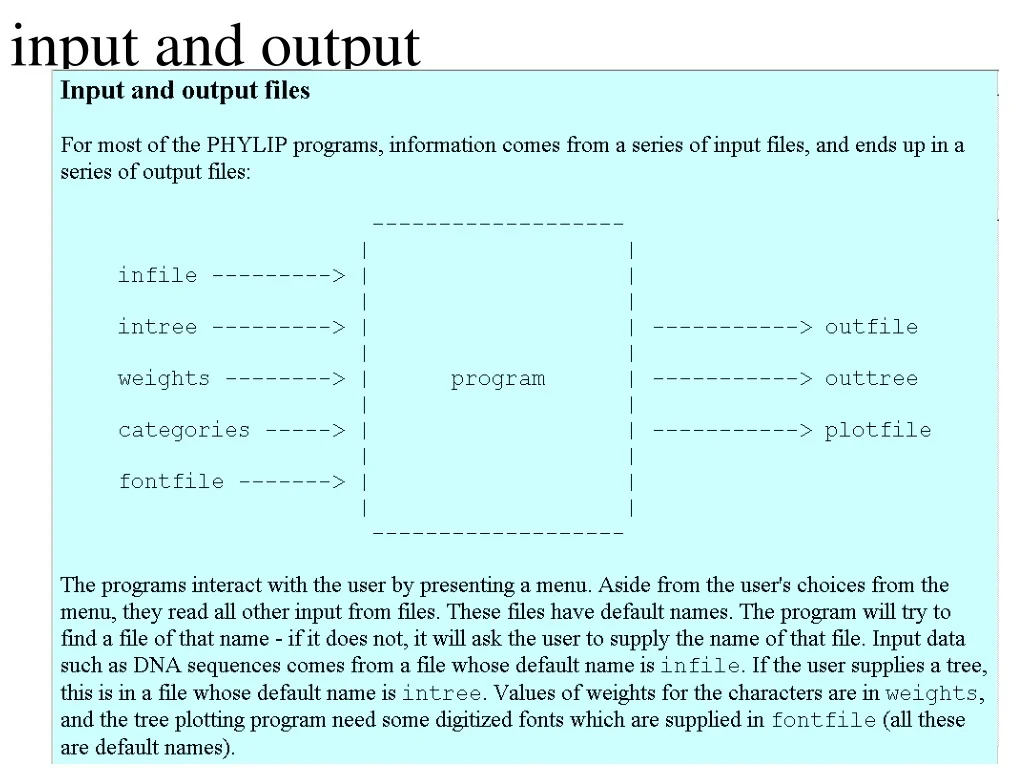
  1. input and output

  2. What’s in PHYLIP Programs in PHYLIP allow to do parsimony, distance matrix, and likelihood methods, including bootstrapping and consensus trees. Data types that can be handled include molecular sequences, gene frequencies, restriction sites and fragments, distance matrices, and discrete characters. Phylip works well with protein and nucleotide sequences Many other programs mimic the style of PHYLIP programs. (e.g. TREEPUZZLE, phyml, protml) Many other packages use PHYIP programs in their inner workings (e.g., PHYLO_WIN) PHYLIP runs under all operating systems Web interfaces are available

  3. Programs in PHYLIP are Modular For example: PROTDIST takes a aligned sequences (one or many sets) and calculates distance matices (one or many) FITCH (or NEIGHBOR) calculate best fitting or neighbor joining trees from one or many distance matrices …. modules are available to draw trees as well, but often people use treeview or njplot

  4. is an excellent source of information. The Phylip Manual Brief one line descriptions of the programs are here The easiest way to run PHYLIP programs is via a command line menu (similar to clustalw). The program is invoked through clicking on an icon, or by typing the program name at the command line. > protdist > neighbor If there is no file called infile the program responds with: [gogarten@carrot gogarten]$ seqboot seqboot: can't find input file "infile" Please enter a new file name>

  5. program folder

  6. menu interface