Rat Brain Robot
Delve into the fascinating world of cyborgs, where biological and artificial components merge. Discover the Rat Brain Robot, an innovative creation controlled by neurons from a rat's brain, designed to move and learn autonomously. This robot, equipped with sonar and no microprocessor, exemplifies advanced research in artificial intelligence and robotics. With the potential to integrate human neurons in the future, the ethical implications regarding consciousness and rights arise. Join us in exploring this cutting-edge intersection of biology and technology.

Rat Brain Robot
E N D
Presentation Transcript
RatBrainRobot Thecyborgofour time Hugo Ribeiro Baldioti
Cyborgs • Cyberneticorganism • Biologicaland artificial parts
Human living cyborgs • Neil Harbisson • Rob Spence • Kevin Warwick
Kevin Warwick • Professor of Cybernetics at the University of Reading, England • Artificial intelligence, control, robotics and biomedical engineering
Kevin Warwick • Project Cyborg 1.0 (1998) • Project Cyborg 2.0 (2002)
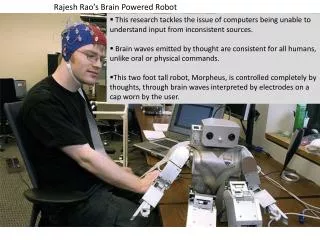
Ratbrainrobot • Controlledbyneuronsfrom a rat’sbrain • A robotconsistingoftwowheelswith a sonar sensor • Has no microprocessorofit’sown
How it works? • Embryonicneurons are separated out andallowed to growon na electrodearray • A meshofabout 100000 neuronscangrowwithinseveraldays • Afterabout a weekhe starts to pulse theelectrodes in search of a pathway
How it works? • Oncetheyhave a pathwayresearchers use the connection to gettherobot to roam aroundandlearn to avoidcrashingintowalls • Bluetooth communication • With time andrepetitionthe neural pathwaybecomestronger • Therobotlearn for itselfhow to notbashintoobstacles
Show Video • http://www.youtube.com/watch?feature=player_embedded&v=1QPiF4-iu6g&gl=BR
Future... • Cultureneurons in threedimensions • A network of 30 millionneurons • Afterthat, thenextstepwillbe to bring in humanneurons
Nowwhat? • Ifwehave 100 billionhumanneurons Shouldwegive it rights? Does it get to vote? Is it conscious?
TheEnd hugo.baldioti@engenharia.ufjf.br