Download
1 / 28
290 likes | 485 Vues
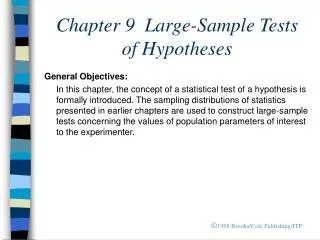
This article outlines the steps for conducting large sample significance tests for a mean, as per Deming’s methodology. It starts with stating the null and alternative hypotheses, followed by defining test criteria, including the test statistic and its corresponding reference distribution. Sample calculations are demonstrated, along with reporting the observed level of significance (p-value) and its implications for real-world engineering problems. It emphasizes that while hypothesis testing and p-values are popular, confidence intervals may provide more meaningful insights, reflecting Deming’s views on the practicality of statistical significance testing.

E N D
6.2 Large Sample Significance Tests for a Mean “The reason students have trouble understanding hypothesis testing may be that they are trying to think.” Deming
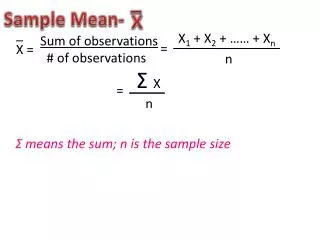
Steps (p. 350) • Steps 1 and 2: State the null and alternative hypothesis. • Step 3: State the test criteria. That is, give the formula for the test statistic (plugging in only the hypothesized value from the null hypothesis but not any sample information) and the reference distribution. Then state in general terms what observed values of the test statistic constitute evidence against the null hypothesis.
Step 4: Show the sample based calculations. • Step 5: Report an observed level of significance, p-value, and (to the extent possible) state its implications in the context of the real engineering problem.
P-values and hypothesis testing are widely used. • However, in my opinion and some others’ opinions (see author’s comments later in the chapter), more often than not, such significance tests are not useful summaries. See Deming quote earlier. • Generally, confidence intervals are more useful summaries.