Understanding Motion and Perceptual Organization in Visual Perception
This text explores the critical role of motion as a perceptual cue in understanding dynamic scenes. It discusses how even limited motion data can evoke strong perceptual responses, referencing foundational work by G. Johansson on biological motion. The piece further examines applications of motion in estimating 3D structures, segmenting objects, and recognizing activities, alongside concepts like motion fields and optical flow. Insights into how depth affects perceived motion and the implications of lighting changes on motion perception are also highlighted, providing a comprehensive overview of the topic.

Understanding Motion and Perceptual Organization in Visual Perception
E N D
Presentation Transcript
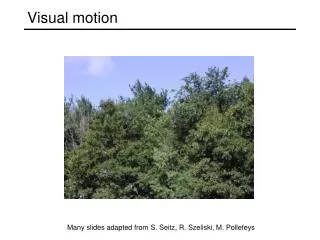
Visual motion Many slides adapted from S. Seitz, R. Szeliski, M. Pollefeys
Motion and perceptual organization • Sometimes, motion is the only cue
Motion and perceptual organization • Sometimes, motion is the only cue
Motion and perceptual organization • Even “impoverished” motion data can evoke a strong percept G. Johansson, “Visual Perception of Biological Motion and a Model For Its Analysis", Perception and Psychophysics 14, 201-211, 1973.
Motion and perceptual organization • Even “impoverished” motion data can evoke a strong percept G. Johansson, “Visual Perception of Biological Motion and a Model For Its Analysis", Perception and Psychophysics 14, 201-211, 1973.
Motion and perceptual organization • Even “impoverished” motion data can evoke a strong percept G. Johansson, “Visual Perception of Biological Motion and a Model For Its Analysis", Perception and Psychophysics 14, 201-211, 1973.
Uses of motion • Estimating 3D structure • Segmenting objects based on motion cues • Learning and tracking dynamical models • Recognizing events and activities
Motion field • The motion field is the projection of the 3D scene motion into the image
Motion field and parallax • X(t) is a moving 3D point • Velocity of scene point: V = dX/dt • x(t) = (x(t),y(t)) is the projection of X in the image • Apparent velocity v in the image: given by components vx = dx/dt and vy = dy/dt • These components are known as the motion field of the image X(t+dt) V X(t) v x(t+dt) x(t)
Motion field and parallax X(t+dt) To find image velocity v, differentiate x=(x,y) with respect to t (using quotient rule): V X(t) v x(t+dt) x(t) Image motion is a function of both the 3D motion (V) and thedepth of the 3D point (Z)
Motion field and parallax • Pure translation: V is constant everywhere
Motion field and parallax • Pure translation: V is constant everywhere • The length of the motion vectors is inversely proportional to the depth Z • Vzis nonzero: • Every motion vector points toward (or away from) the vanishing point of the translation direction
Motion field and parallax • Pure translation: V is constant everywhere • The length of the motion vectors is inversely proportional to the depth Z • Vzis nonzero: • Every motion vector points toward (or away from) the vanishing point of the translation direction • Vz is zero: • Motion is parallel to the image plane, all the motion vectors are parallel
Optical flow • Definition: optical flow is the apparent motion of brightness patterns in the image • Ideally, optical flow would be the same as the motion field • Have to be careful: apparent motion can be caused by lighting changes without any actual motion • Think of a uniform rotating sphere under fixed lighting vs. a stationary sphere under moving illumination