Understanding Meshes, Fields, and Interpolation: Unstructured Grids and Tetrahedral Algorithms
280 likes | 406 Vues
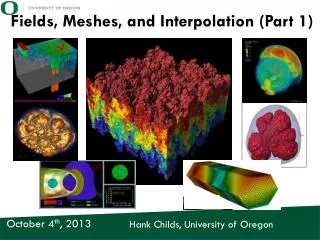
This lecture by Hank Childs at the University of Oregon covers advanced topics in computational geometry, focusing on unstructured grids and interpolation techniques, particularly within tetrahedrons. Key points include types of meshes, adaptive mesh refinement, and storage schemes for unstructured meshes. The session also explores algorithms for finding external faces in mesh data and methods for interpolating values at arbitrary points within tetrahedral cells. Students are required to present final projects, contributing to their overall grade as part of mandatory attendance.


Understanding Meshes, Fields, and Interpolation: Unstructured Grids and Tetrahedral Algorithms
E N D
Presentation Transcript
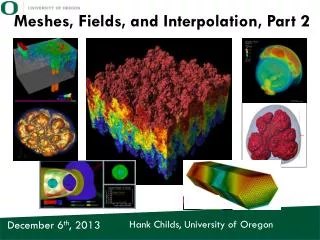
Meshes, Fields, and Interpolation, Part 2 Hank Childs, University of Oregon December 6th, 2013
Upcoming Schedule • 12/6: unstructured grids • Faculty fireside (parallel visualization): • Week of 12/9 • Final: Thurs 12/12, 3:15PM, Rm 220
Announcements • Final projects: • Custom projects (~20): • bring up to 5 min presentation • Auxiliary grading time possible • Movies (~10): • prepare to show off your movie • ~3 mins • total ~2 hours (might be a little long) • Private (offline) demonstrations if necessary
Announcements • Kristi, Erik, and I will judge them, award best project & best movie • Location: Rm 220 (colloquium room) • Attendance is mandatory (& graded), even for ray casters • Late policy: • 80% of the points if you are two days late, • 60% of the points if you are four days late, • 50% of the points any time thereafter • Final project worth 35% of your grade
An example mesh Why do you think the triangles change size?
Types of Meshes Adaptive Mesh Refinement Curvilinear Unstructured
Curvilinear Mesh • Logically rectilinear • Each cell has an (i, j) • Always left, right, bottom, top neighbor (unless on boundary) • Points can be anywhere … as long as the cells don’t overlap VTK calls this “vtkStructuredGrid”
Curvilinear Mesh • A curvilinear mesh has 5x5 cells and a cell-centered variable stored. • Quiz: how many bytes to store this data set if all data is in single precision floating point? 2 ints + 6x6 floats (points) + 5x5 floats (variable) = 2*4+36*4+25*4 = 63*4 = 272 bytes
Example unstructured mesh • Meshes contain: • Cells • Points • This mesh contains 3 cells and 13 vertices • Pseudonyms: • Cell == Element == Zone • Point == Vertex == Node
Example unstructured mesh A: 1 int (# cells), 3 ints (# pts per cell), 24+24+15 floats = 268 bytes • Cell 0: • { (0, 0, 0), // 10 (1, 0, 0), // 11 (1, 1, 0), // 8 (0, 1, 0), // 7 (0, 0, 1), // 4 (1, 0, 1), // 5 (1, 1, 1), // 2 (0, 1, 1) } // 1 Let’s call this the “explicit” scheme If we stored each cell like this, how many bytes would it take? (assume single precision)
Example unstructured mesh • Pts: • {(0, 1, 1), (1, 1, 1), (2,1,1), (0,0,1), (1,0,1), (2,0,1), (0,1,0), (1,1,0), (2,1,0), (0,0,0), (1,0,0), (2,0,0), (2.5, 0.5, 0.5)} • Cells: • 3 cells • 1st cell: hexahedron • (10,11,8,7,4,5,2,1) • 2nd cell: hexahedron • (11,12,9,8,5,6,3,2) • 3rd cell: prism • (13,3,6,12,9) Let’s call this the “connectivity” scheme If we stored each cell like this, how many bytes would it take? (assume single precision) A: 1 int (# pts), 1 int (# cells), 3 ints (# cell type), 13*3 floats (pts), 8+8+5 ints = 260 bytes
Comparing unstructured mesh storage schemes • Hexahedral meshes: each internal point incident to 8 cells • Explicit scheme: • represent that point 8 times: 24 floats for storage • Connectivity scheme: • represent that point once in point list, 8 times in connectivity list: 3 floats + 8 ints Further benefit to connectivity scheme is in finding exterior faces.
Finding external faces: motivation • Interval volume, clip: • Take data set (rectilinear, unstructured, or other) and produce unstructured mesh • When rendering, only want to render the faces on the outside (the inside aren’t visible) Question: what proportion of faces are exterior? Question: how to find exterior faces?
Finding external faces: algorithm • For each face, count how many cells are incident. • If “1”, then external • If “2”, then interior Question: why does this work?
Finding exterior faces: algorithm • Estimate # of faces (ncells * 6 / 2) • Double that number • Create a hash table of that size • For each cell C • For each face F of C • Create hash index for F based on connectivity indices • Search hash table • If F already there, remove F from hash • If face not there, add F to hash • All faces in hash are exterior
Interpolation for arbitrary cells: tetrahedrons • Assume tetrahedron T, point P in T • Goal: calculate F(P) P3 P2 P P0 P1
Interpolation for arbitrary cells: tetrahedrons • Assume tetrahedron T, point P in T • Goal: calculate F(P) P3 P2 P P0 T S R P1 Set up parametric coordinate system
Interpolation for arbitrary cells: tetrahedrons • Assume tetrahedron T, point P in T • Goal: calculate F(P) P = P0+aR+bS+cT P3 P2 This is a 3x3 matrix solve. This matrix is invertible since R,S,T form a basis P P0 T S R P1 Calculate parametric coordinates (a,b,c)
Interpolation for arbitrary cells: tetrahedrons • Assume tetrahedron T, point P in T • Goal: calculate F(P) P3 P = P0+aR+bS+cT F(P) = sum(Wi*F(Pi)) W0 = 1-a-b-c W1 = a W2 = b W3 = c P2 P P0 T S P1 R Calculate F(P) as weighted sum of vertices
General idea • Set up parametric coordinate system • Calculate parametric coordinates for P • Calculate F(P) as Sum(Wi*F(Pi)) • Weights Wi can get pretty tricky. VTK book has weights & good description in Ch. 8.2.
How to do contouring • Basically the same: • Iterate over cells • Identify case • Lookup case in table • Create resulting geometry • Difference: • New tables for each cell type
How to do ray casting • Basically the same: • Cast rays for every pixel on the screen • Sample along rays • Apply transfer function • Composite front to back • Assign color to image • Differences: • Sampling gets hard! • Which cell contains a sample point? • Need smart data structures …. • …. Or a way to transform data to make it easy
How to do particle advection • Basically the same: • Start with a seed location • Evaluate velocity • Displace particle • Repeat until termination criteria reached • Differences: • Evaluating velocity different x2: • Now a harder proposition: which cell contains particle? • Now more math: how to LERP velocity?
Adaptive Mesh Refinement • Put resolution where you want it… • … but simpler than unstructured (indexing & interpolation) and cheaper (memory) • Problems: • Everything great, except at the boundaries….
Looking Back: This Class • I hope you learned: the theory of scientific visualization • Visualization is for 3 main use cases: • Communication • Confirmation • Exploration • Enables the scientific method • Many visual metaphors for representing data • What are the tools? • How to choose the right tool from the toolbox? • What are the systems that support the tools?
Looking Back: This Class • I hope you learned: how to be a better programmer • These projects were challenging • I hope you enjoyed them • I hope you learned from them Brag about these … put thumbnails on your resumes
My Unsolicited Advice • Self-actualize: to realize one’s full potential • If you are not excited about your job, find a new one (*) • Repeat until you are happy or until you are convinced this is the wrong line of work for you. • (*) = Life will get in the way sooner than you think • You have all done extremely well in this class … seek that job with significant technical responsibility. • Learn about yourself
Thank you!! • It has been a privilege to teach this class and get to know you all. • I appreciate the earnest effort you have put forth • I appreciate you bearing with me through many mistakes • (The good news is that we will now have qualified TAs to choose from the next time we offer this course!!)