Understanding Two-Dimensional Random Variables and Their Joint Distributions
This chapter focuses on two-dimensional random variables, introducing the concept of n-dimensional vectors made up of random variables. It elaborates on the joint distribution of random vectors, detailing the cumulative distribution function (CDF) for two random variables and its geometric interpretation. Key concepts include the properties of joint distributions, both discrete and continuous, and examples demonstrating how to calculate probabilities within defined regions. The chapter concludes with a discussion on the characteristics of joint distributions and the implications for statistical analysis.

Understanding Two-Dimensional Random Variables and Their Joint Distributions
E N D
Presentation Transcript
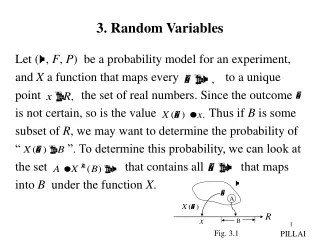
3.1 Two-Dimensional Random Variables 1.n-dimensional variables n random variables X1,X2,...,Xn compose a n-dimensional vector (X1,X2,...,Xn), and the vector is named n-dimensional variables or random vector. 2.Joint distribution of random vector Define function F(x1,x2,…xn)= P(X1≤x1,X2 ≤ x2,...,Xn≤ xn) the joint distribution function of random vector (X1,X2,...,Xn).
The Joint cdf for Two random variables Definition 3.1-P53 Let (X, Y) be 2-dimensional random variables. Define F(x,y)=P{Xx, Yy} the bivariate cdf of (X, Y). Geometric interpretation:the value of F( x, y) assume the probability that the random points belong to area in dark
For (x1, y1), (x2, y2)R2, (x1<x2, y1<y2 ), then P{x1<Xx2, y1<Yy2 } =F(x2, y2)-F(x1, y2)- F (x2, y1)+F (x1, y1). (x1, y2) (x2, y2) (x1, y1) (x2, y1)
EX Suppose that the joint cdf of (X,Y) is F(x,y), find the probability that (X,Y) stands in area G . G Answer
Joint distribution F(x, y) has the following characteristics: (1)For all(x, y) R2 , 0 F(x, y) 1,
(2) Monotonically increment for any fixed y R, x1<x2yields F(x1, y) F(x2 , y); for any fixed x R, y1<y2yields F(x, y1) F(x , y2). (3) right continuous for xR, yR,
(4) for all (x1, y1), (x2, y2)R2, (x1<x2, y1<y2 ), F(x2, y2)-F(x1, y2)- F (x2, y1)+F (x1, y1)0. Conversely, any real-valued function satisfied the aforementioned 4 characteristics must be a joint distribution function of 2-dimensional variables.
Example 1. Let the joint distribution of (X,Y) is • Find the value of A,B,C。 • Find P{0<X<2,0<Y<3} Answer
Discrete joint distribution If both x and y are discrete random variable, then,(X, Y) take values in (xi, yj), (i, j=1, 2, … ), it is said that X and Y have a discrete joint distribution. Definition 3.2-P54 Thejoint distribution is defined to be a function such that for any points(xi, yj), P{X=xi, Y= yj,}= pij , (i, j=1, 2, … ). That is (X, Y)~ P{X=xi, Y= yj,}= pij ,(i, j=1, 2, … ),
The joint distribution can also be specified in the following table X Y y1 y2 … yj … p11p12 ...P1j ... p21p22 ...P2j ... pi1pi2 ...Pij ... x1 x2 xi ... ... ... ... ... ... ... ... • Characteristics of joint distribution : • pij0 , i, j=1, 2, … ; • (2)
Example 2. Suppose that there are two red balls and three white balls in a bag, catch one ball from the bag twice without put back, and define X and Y as follows: Please find the joint pmf of (X,Y) Y 1 0 X 1 0
Continuous joint distributions and density functions 1. It is said that two random variables (X, Y) have a continuous joint distribution if there exists a nonnegative function f (x, y) such that for all (x, y)R2,the distribution function satisfies and denote it with (X, Y)~ f (x, y), (x, y)R2
2. characteristics of f(x, y) (1)f (x, y)0, (x, y)R2; (2) (3) (4) For any region G R2,
EX Let Find P{X>Y} y 1 G 1 x
EX Find (1)the value of A; (2) the value of F(1,1); (3) the probability of (X, Y) stand in region D:x0, y0, 2X+3y6 1 Answer (1) Since 1