Bivariate and Multivariate Normal Random Variables
Bivariate and Multivariate Normal Random Variables. Lecture XIII. Bivariate Normal Random Variables. Definition 5.3.1. The bivariate normal density is defined by.

Bivariate and Multivariate Normal Random Variables
E N D
Presentation Transcript
Bivariate and Multivariate Normal Random Variables Lecture XIII
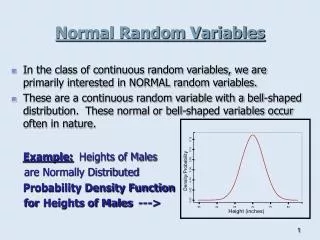
Bivariate Normal Random Variables • Definition 5.3.1. The bivariate normal density is defined by
Theorem 5.3.1. Let (X,Y) have the bivariate normal density. Then the marginal densities f(x) and f(y) and the conditional densities f(y|x) and f(x|y) are univariate normal densities, and we have E[X]=mX, V[X]=sX2, E[Y]=mY, V[Y]=sY2, Corr(X,Y)=r, and
where f1 is the density of N(mX,sX2) and f2 is the density function of N[mY+rsYsx-1(x-mX),sY2(1-r2)]. The proof of the assertions from the theorem can then be seen by:
This gives us X~N(mX,sX). Next we have • By Theorem 4.4.1 (Law of Iterated Means) E[(X,Y)]=EXEY|X[(X,Y)] (Where the symbol EX denotes the expectation with respect to X).
Theorem 5.3.2. If X and Y are bivariate normal and a and b are constants, then aX+bY is normal. • Theorem 5.3.3. Let {Xi}, i=1,2,…,n be pairwise independent and identically distributed as N(m,s2). Then is N(m,s2/n). • Theorem 5.3.4. If X and Y are bivariate normal and Cov(X,Y)=0, then X and Y are independent.
Multivariate Normal Distribution • Definition 5.4.1. We way x is multivariate normal with mean m and variance-covariance matrix S, denoted N(m,S), if its density is given by
Matrix Operations • Note first that |S| denotes the determinant of the variance matrix. The determinant is found by expansion down a row or column of a matrix:
Conditional Formulations • Matrix Form of Conditional Variance: Let X be a vector of normally distributed random variables:
Let Y composed of a vector of (Y1’,Y2’) be defined based on X by:
The matrix B is defined such that Y1 is uncorrelated with Y2. Mathematically