Normal Random Variables
Learn about normal density, mean, variance, linear transformations, and probability calculations in the context of the normal distribution. Explore the theorems and applications related to normal random variables.

Normal Random Variables
E N D
Presentation Transcript
Normal Random Variables Lecture XII
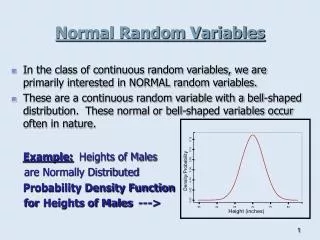
Univariate Normal Distribution. • Definition 5.2.1. The normal density is given by • When X has the above density, we write symbolically X~N(m,s2).
Mean and Variance of Normal Distribution • Theorem 5.2.1. Let X be distributed N(m,s2). Then E[X]= m and V[X]= s2
The first term of the integration by parts is clearly zero while the second is defined by polar integral. Thus,
Normality of a Linear Transformation • Theorem 5.2.2. Let X be distributed N(m,s2) and let Y=a+bX. Then we have Y~N(a+bm,b2s2). • This theorem can be demonstrated using Theorem 3.6.1 (the theorem on changes in variables):
Note that probabilities can be derived for any normal based on the standard normal integral. Specifically, in order to find the probability that X~N(10,4) lies between 4 and 8 (P[4<X<8]) implies:
Thus, the equivalent boundary becomes where z is a standard normal variable. These values can be found in a standard normal table as P[z<-1]=.1587 and P[z<-3]=.0013.
As a first step, I want to graph two distributions with the same mean and variance. • I want to start with a binomial distribution with probability .5 and 20 draws. • This distribution has a mean of 10 and a variance of 5.