Download
1 / 12
120 likes | 247 Vues
Learn about molecular structure through Lewis diagrams and the Octet Rule. Atoms bond to achieve a stable configuration of 8 valence electrons, though there are exceptions, such as hydrogen with 2 electrons and certain elements that can exceed 8 (expanded octet). This guide details drawing Lewis diagrams, including how to calculate total valence electrons, the arrangement of atoms, forming bonds, and addressing polyatomic ions. Additionally, explore resonance structures for molecules that have multiple valid representations.

E N D
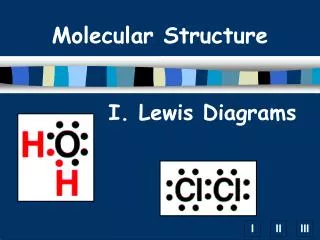
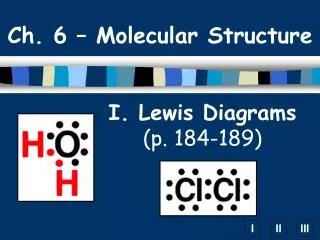
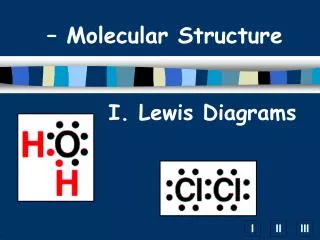
– Molecular Structure I. Lewis Diagrams
A. Octet Rule • Remember… • Most atoms form bonds in order to have 8 valence electrons.
F F F S F F F F B F F H O H N O Very unstable!! A. Octet Rule • Exceptions: • Hydrogen 2 valence e- • Groups 1,2,3 get 2,4,6 valence e- • Expanded octet more than 8 valence e- (e.g. S, P, Xe) • Radicals odd # of valence e-
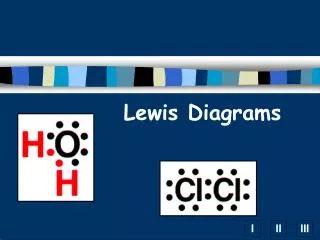
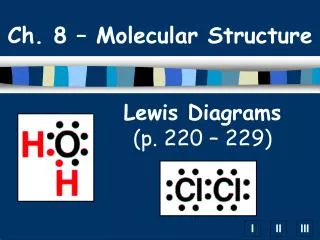
B. Drawing Lewis Diagrams • Find total # of valence e-. • Arrange atoms - singular atom is usually in the middle. • Form bonds between atoms (2 e-). • Distribute remaining e- to give each atom an octet (recall exceptions). • If there aren’t enough e- to go around, form double or triple bonds.
B. Drawing Lewis Diagrams • CF4 1 C × 4e- = 4e- 4 F × 7e- = 28e- 32e- F F C F F - 8e- 24e-
B. Drawing Lewis Diagrams • BeCl2 1 Be × 2e- = 2e- 2 Cl × 7e- = 14e- 16e- ClBeCl - 4e- 12e-
B. Drawing Lewis Diagrams • CO2 1 C × 4e- = 4e- 2 O × 6e- = 12e- 16e- OCO - 4e- 12e-
C. Polyatomic Ions • To find total # of valence e-: • Add 1e- for each negative charge. • Subtract 1e- for each positive charge. • Place brackets around the ion and label the charge.
C. Polyatomic Ions • ClO4- 1 Cl × 7e- = 7e- 4 O × 6e- = 24e- 31e- O O Cl O O + 1e- 32e- - 8e- 24e-
C. Polyatomic Ions • NH4+ 1 N × 5e- = 5e- 4 H × 1e- = 4e- 9e- H H N H H - 1e- 8e- - 8e- 0e-
D. Resonance Structures • Molecules that can’t be correctly represented by a single Lewis diagram. • Actual structure is an average of all the possibilities. • Show possible structures separated by a double-headed arrow.
O O S O O O S O O O S O D. Resonance Structures • SO3