Download
1 / 7
70 likes | 184 Vues
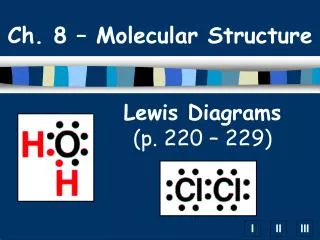
This guide provides a comprehensive overview of molecular structure, focusing on the Octet Rule and the principles of drawing Lewis diagrams. Atoms bond to achieve stable electron configurations, usually aiming for eight valence electrons. Exceptions to the rule are highlighted, such as hydrogen, which seeks two electrons, and elements that can accommodate more than eight electrons. Step-by-step instructions for creating Lewis diagrams are included, along with examples such as CF4 and CO2, demonstrating how to effectively distribute valence electrons to achieve stability.

E N D
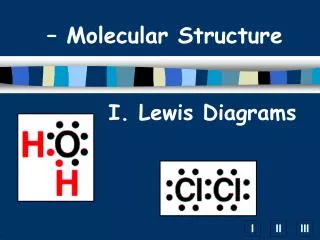
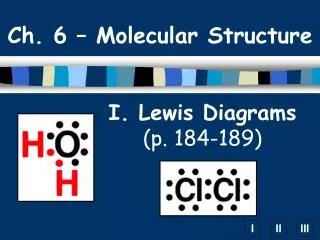
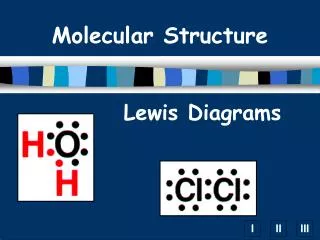
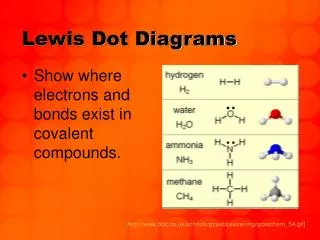
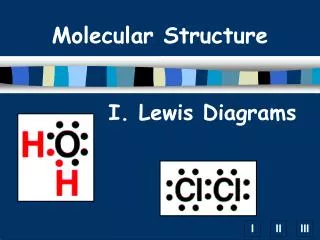
Molecular Structure I. Lewis Diagrams
A. Octet Rule • Remember… • Most atoms form bonds in order to have 8 valence electrons.
F F F S F F F F B F F H O H N O Very unstable!! A. Octet Rule • Exceptions: • Hydrogen 2 valence e- • Groups 1,2,3 get 2,4,6 valence e- • Expanded octet more than 8 valence e- (e.g. S, P, Xe) • Radicals odd # of valence e-
B. Drawing Lewis Diagrams • Find total # of valence e-. • Arrange atoms - singular atom is usually in the middle. • Form bonds between atoms (2 e-). • Distribute remaining e- to give each atom an octet (recall exceptions). • If there aren’t enough e- to go around, form double or triple bonds.
B. Drawing Lewis Diagrams • CF4 1 C × 4e- = 4e- 4 F × 7e- = 28e- 32e- F F C F F - 8e- 24e-
B. Drawing Lewis Diagrams • BeCl2 1 Be × 2e- = 2e- 2 Cl × 7e- = 14e- 16e- ClBeCl - 4e- 12e-
B. Drawing Lewis Diagrams • CO2 1 C × 4e- = 4e- 2 O × 6e- = 12e- 16e- OCO - 4e- 12e-