Workshop Summary: Product Cluster Discussions and Indicator Development on June 19th
70 likes | 196 Vues
This workshop focused on addressing questions from previous discussions held in Brussels and Helsinki. It aimed to define product boundaries, determine functional units, and discuss qualitative and social indicators. The group analyzed selected examples of indicators, progressing towards a final version of the Indicator Development Structure (IDS) and Database (DB). Additionally, the results will be forwarded to validate with network "staff." Topics included product definitions per EU directives, durability, service life, and the need for user-friendly product indicators, among other relevant themes.


Workshop Summary: Product Cluster Discussions and Indicator Development on June 19th
E N D
Presentation Transcript
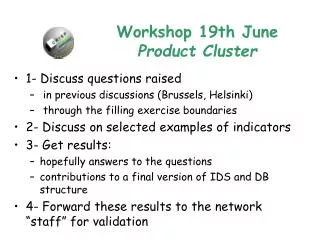
Workshop 19th JuneProduct Cluster • 1- Discuss questions raised • in previous discussions (Brussels, Helsinki) • through the filling exercise boundaries • 2- Discuss on selected examples of indicators • 3- Get results: • hopefully answers to the questions • contributions to a final version of IDS and DB structure • 4- Forward these results to the network “staff” for validation
Questions raised (1/2) • Cluster boundaries, • what is a product (EU Directive, IPP,..) • product in works, including packaging, installation and maintenance additional materials,.... • Functional Unit and data quality • Qualitative indicators for products? • Social indicators for products? • Specific Indicators • for a material • for a function
Answers (1/2) • Cluster boundaries, • product definition according to EU Directive, but also EPD (Environmental Product Declaration) • Functional Unit: see above • Data quality: existing tools (NUSAP), but is it in the CRISP scope? • Qualitative indicators for products: relevant only if no quantitative one available • Social indicators for products: open debate • Specific Indicators: • for materials:NO, for functions: more recommendation
Questions raised (2/2) • Classification: • type to be filled by one expert (the same for all IDS) • category: where is durability/service life • keywords: only for name and description • Users: do they need/use product indicators? • In the Vikki example: • number of products/materials with eco-labels • in health criteria: “no toxic or dubious materials” • Sets/Systems: reference or link to the set or system, but IDS for set/systems also?
Answers (2/2) • Classification: • type to be filled by one expert, agreed already • durability as such: not an indicator • service life in economic, and if environmental, included in the functional unit • keywords: only for name and description (as agreed) • Users: do they need/use product indicators? • Yes, Norway examples: indoor air quality index, chemicals content • Sets/Systems: reference or link to the set or system, but IDS for set/systems also? (as agreed)
Selected indicators from the filling exercise • H1: Durability of load bearing reinforced concrete structural components exposed to urban air and pollution: theindicator should be the level of protection, or the additive to avoid degradation • H2: Heat loss through windows by transmission:OK • N9 (G6): use of recycled materials: more a recommendation, the indicator should be %, excluding internal recycling • G10: transportation included in a product: OK • G8: product complexity: interesting, but how we measure? • Fr1(G1): Typical Service Life: discussed previously
Selected indicators new suggestions • Social acceptance: debate • “Replaçability”: Ease of dismantling • Availability of an EPD or an eco-label: OK • more ideas (better if actually used) • ...