Physics and the Quantum Mechanical Model Notes
Physics and the Quantum Mechanical Model Notes. Light and the Atomic Spectrum. Light is composed of waves at different wavelengths The wave is composed of: Wavelength (λ): is the distance between the crests Frequency (ν): the number of wave cycles to pass a point per time

Physics and the Quantum Mechanical Model Notes
E N D
Presentation Transcript
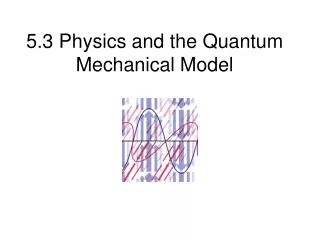
Light and the Atomic Spectrum • Light is composed of waves at different wavelengths • The wave is composed of: • Wavelength (λ): is the distance between the crests • Frequency (ν): the number of wave cycles to pass a point per time • Amplitude: The height of the crest from the origin
You can calculate the frequency and wavelength of light using the equation c= λν c = speed of light(3.0 x 1010 cm/s or 3.0 x 10⁸ m/s) λ = wavelength (cm or m – distance between crests) ν = frequency (1/s or s-1 = hertz = Hz)
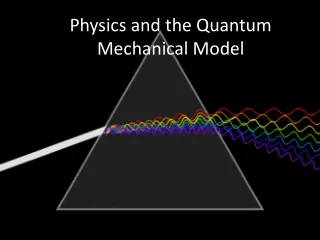
Electromagnetic Spectrum • Visible Light is composed of a small section of the Electromagnetic Spectrum • EMS- a scale of all forms of radiation that exhibit wave-like behavior as they travel through space • Light can be broken up into a spectrum of colors (ROY G BIV) red – orange - yellow – green – blue – indigo- violet Violet is the highest energy (shortest wavelength) Red is the lowest energy (longest wavelength)
Types of Spectra • Continuous: Produced by a hot, opaque (dense gas or solid). A RAINBOW of colors • Emission/Dark Line: Produced by a hot, transparent gas • Absorption: Produced by a cool, transparent gas
Atomic Emission Spectrum • Each element has its own unique emission spectrum when it is excited • Excitation is usually induced via heat, electricity, etc. • Excited = move up an energy level (absorb a “quanta” of energy. When e moves back to ground state, a quanta of energy (called a PHOTON is released
Quanta = “Packet” of Energy • Photon: “particle” of electromagnetic radiation. ZERO mass, carries a quantum (amount) of energy • When an electrons falls back to it’s natural (non “excited state”) it’s seen a light and felt as heat
Photoelectric Effect (Solar Cells) • Metals eject electrons called photoelectrons when light shines on them (energy not emitted continuously) • Plank showed relationship between the intensity of light shined on metal (frequency) and amount of electrical current produce (Energy).
Plank’s Constant E = h x v E = radiant energy h = 6.6262 x 10⁻³⁴ Jxs (Plank’s Constant) = Energy of one photon v = frequency of the radiation (Hz) Frequency (v) and Energy (E) directly proportional!
De Broglie equation • Wave-particle duality: Particles exhibit wave and particle properties (not just light but ALL matter) λ = h / mv m = mass of particle h = 6.6262 x 10⁻³⁴ Jxs (Plank’s Constant)