Advancements in High Energy Laser Propagation: Modeling, Simulation, and Adaptive Control
This research, funded by AFOSR, focuses on the latest advancements in the modeling, simulation, tracking, and control of high-energy lasers. Key contributions from teams at UCLA, Michigan Tech, and Georgia Tech have led to significant improvements in adaptive optics and jitter control methods. UCLA’s novel algorithms have enhanced laser beam control and target tracking, showing a 77% increase in HEL intensity on target during tests. Collaborations with industry partners are driving further developments in wavefront sensing and tracking through turbulent conditions.

Advancements in High Energy Laser Propagation: Modeling, Simulation, and Adaptive Control
E N D
Presentation Transcript
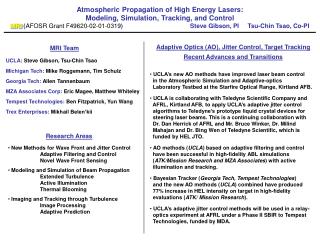
Atmospheric Propagation of High Energy Lasers: Modeling, Simulation, Tracking, and ControlMRI (AFOSR Grant F49620-02-01-0319) Steve Gibson, PI Tsu-Chin Tsao, Co-PI Adaptive Optics (AO), Jitter Control, Target Tracking Recent Advances and Transitions MRI Team UCLA: Steve Gibson, Tsu-Chin Tsao Michigan Tech: Mike Roggemann, Tim Schulz Georgia Tech: Allen Tannenbaum MZA Associates Corp: Eric Magee, Matthew Whiteley Tempest Technologies: Ben Fitzpatrick, Yun Wang Trex Enterprises: Mikhail Belen’kii • UCLA’s new AO methods have improved laser beam control in the Atmospheric Simulation and Adaptive-optics Laboratory Testbed at the Starfire Optical Range, Kirtland AFB. • UCLA is collaborating with Teledyne Scientific Company and AFRL, Kirtland AFB, to apply UCLA’s adaptive jitter control algorithms to Teledyne’s prototype liquid crystal devices for steering laser beams. This is a continuing collaboration with Dr. Dan Herrick of AFRL and Mr. Bruce Winker, Dr. Milind Mahajan and Dr. Bing Wen of Teledyne Scientific, which is funded by HEL JTO. • AO methods (UCLA) based on adaptive filtering and control have been successful in high-fidelity ABL simulations (ATK/Mission Research and MZA Associates) with active illumination and tracking. • Bayesian Tracker (Georgia Tech, Tempest Technologies) and the new AO methods (UCLA) combined have produced 77% increase in HEL intensity on target in high-fidelity evaluations (ATK/ Mission Research). • UCLA’s adaptive jitter control methods will be used in a relay- optics experiment at AFRL under a Phase II SBIR to Tempest Technologies, funded by MDA. Research Areas • New Methods for Wave Front and Jitter Control Adaptive Filtering and Control Novel Wave Front Sensing • Modeling and Simulation of Beam Propagation Extended Turbulence Active Illumination Thermal Blooming • Imaging and Tracking through Turbulence Image Processing Adaptive Prediction