
Introduction to Objective-C Syntax: Understanding Method Signatures and Memory Management
E N D
Presentation Transcript
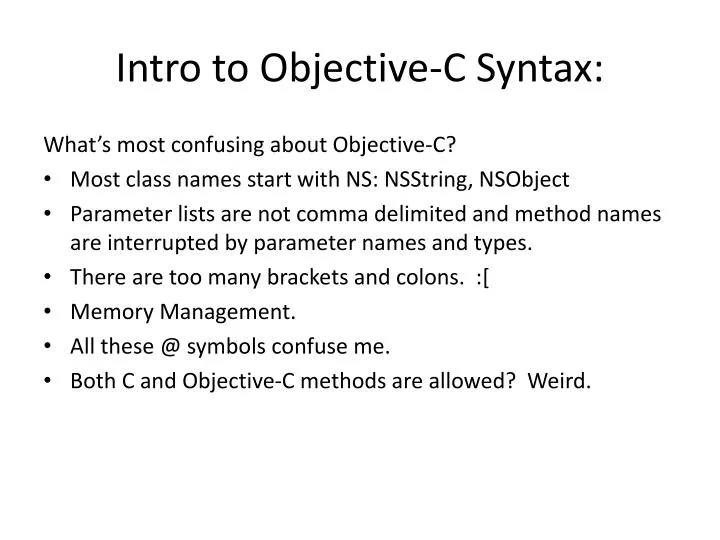
Intro to Objective-C Syntax: What’s most confusing about Objective-C? • Most class names start with NS: NSString, NSObject • Parameter lists are not comma delimited and method names are interrupted by parameter names and types. • There are too many brackets and colons. :[ • Memory Management. • All these @ symbols confuse me. • Both C and Objective-C methods are allowed? Weird.
Intro to Objective-C Syntax: Method Signatures In Java or C: voiddoNothing() { // nothing } intaddThree(intx) { return x + 3; } intmultiplyThreeParameters(intx,inty,intz) { return x * y * z; } // note methods with multiple parameters are given in a parameter list // that is delimited by commas. Key return type method name parameter type parameter name
Intro to Objective-C Syntax: Method Signatures In Objective-C: - (void) doNothing{ // nothing } - (int) addThree:(int) x { return x + 3; } - (int) multiplyThis:(int) xByThis:(int) yAndThis:(int) z { return x * y * z; } // note methods of Objective-C classes with multiple parameters have a space to // delimit the end of the parameter name and the continuation of the method// name. The actually method name is multiplyThis:ByThis:AndThis: Key return type method name parameter type parameter name
Intro to Objective-C Syntax: Accessing methods of objects In Java:object.method(param1, param2); In C++:object->method(param1, param2); In C: (no objects) method(param1, param2);
Intro to Objective-C Syntax: Accessing methods of objects In Objective-C:[object method:param1method:param2]; Example: If you have a string: NSString *msg= @"ALL YOUR BASES BELONG TO US"; And you want to split the sentence into an array of words: NSArray*words = [msgcomponentsSeparatedByString:@" "]; // The @ is required for all string literals, and encodes the string using UTF8
Intro to Objective-C Syntax: Instantiation / Memory Allocation In Java: Objecto = new Object(); // Java takes care of garbage collection. In this statement, memory // is automatically allocated for the new object. Memory is also // automatically released when the object is no longer in use. In C: Object*o = (Object *) malloc(sizeof(Object)); free (o); In C++: Object*o = new Object; delete (o);
Intro to Objective-C Syntax: Instantiation / Memory Allocation In Objective-C: Object*obj= [[Objectalloc] init]; OR Object*obj= [Object new]; [objrelease]; OR [objautorelease]; Golden Rule of Objective-C memory management: When ever you own an object, you must relinquish ownership. I.E. Whenever you call “retain”, “alloc”, “new”, “copy”, or “mutableCopy”, it must be paired with a call to “release” or “autorelease”.
Intro to Objective-C Syntax:Classes • In Java, students can define and implement a class in a single .java file. • In C++, students define a class and methods in a .h header file and implement the methods in a .c file. • In Objective-C, students define a class and its methods in a .h header file and implement the methods in a .m file. Circle.h Circle.m include
Intro to Objective-C Syntax:Classes Circle.h @interface Circle : NSObject{ // instance variables doubleradius = 1.0; } // Class methods +(double) getPi; // Instance methods -(double) getArea; -(void) setRadius:(double) r; @end Key class name superclass return type method name parameter type parameter name Optional parameter name
Circle.m #import "Circle.h" @implementation Circle +(double) getPi { return 3.14159265; } -(double) getArea { double pi = [Circle getPi]; return pi * radius * radius; } -(void) setRadius:(double) r { radius = r; } @end
Main.m #import "Circle.h" // Non Objective-C function; program origin int main() { Circle *mycirc = [[Circle alloc] init]; [mycirc setRadius:3.0]; double area = [mycirc getArea]; double pi = [Circle getPi]; return 0; }