
CLEO-III Systematic Studies Report: Axial and Stereo Tracking Progress and Efficiency Analysis
This report details the systematic studies of the CLEO-III trigger system, focusing on axial and stereo tracking efficiencies. Axial tracking achieves an exceptional efficiency of over 99.9% for particle transverse momentum (PT) greater than 200 MeV. The stereo tracking study, an extension of axial tracking, has shown promising results but will be quantified soon. Additionally, ongoing calorimeter studies aim to understand turn-on behavior and timing issues. This progress report builds on previous work, highlighting collaborative efforts and techniques used in analyzing the data.

CLEO-III Systematic Studies Report: Axial and Stereo Tracking Progress and Efficiency Analysis
E N D
Presentation Transcript
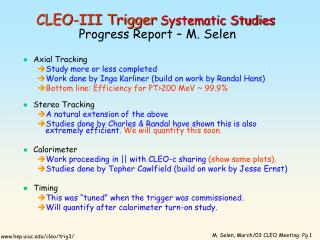
CLEO-III TriggerSystematic StudiesProgress Report – M. Selen • Axial Tracking • Study more or less completed • Work done by Inga Karliner (build on work by Randal Hans) • Bottom line: Efficiency for PT>200 MeV ~ 99.9% • Stereo Tracking • A natural extension of the above • Studies done by Charles & Randal have shown this is also extremely efficient. We will quantify this soon. • Calorimeter • Work proceeding in || with CLEO-c sharing (show some plots). • Studies done by Topher Cawlfield (build on work by Jesse Ernst) • Timing • This was “tuned” when the trigger was commissioned. • Will quantify after calorimeter turn-on study.
Mixer/Shaper Crates (24) Drift Chamber Crates Gates CLEO Mixer/Shaper Boards ctrl. DR3 - TQT G / CAL TILE (16) AXTR(16) AXX(16) Flow control & Gating DFC DAQ ASUM Analog TIM TIM Barrel CC Axial tracker QVME DM/CTL DM/CTL TILE(8) STTR(12) L1D ASUM Stereo tracker Endcap CC QVME TIM DM/CTL Level 1 decision AXPR TRCR CCGL TRCR CC Digital TPRO(4) TIM SURF SURF TPRO(2) DM/CTL TCTL TIM DM/CTL CLEO-III/cTriggerSystemOverview
Layer 9 = “key” InnerLookup OuterLookup Inner/Outer track correlator
“Hadron” “Electron” Tracking Systematic Study • Approach: • Look at CLEO-III Data-5 through Data-16 • Select events that pass EL-track line • (#AX>0)&(#CBmd>0)&(AX+CB time) • Select by L3 classification • Loop over “good” reconstructed tracks (c2/dof<3.5, d0<1.5cm, etc…) • Ignore highest momentum track (assume it caused trigger) • Examine trigger status of all other tracks (did it “pass” or not)
To see if a track “passes” trigger: • Extrapolate fit back to layer 9 to see which of the 112 key wires should be asserted. • See if the track-finding hardware for this wire, or either of its immediate neighbors, reports a correlated track. • A track is called “Isolated” if there are no other tracks within ±5 key wires. • If trigger does not fire,see if its because of: • Missing hits (OK) • Hardware (BAD) • Study as a function oftracks PT and cos(q)
No Trigger - hardware “Isolated Tracks” In Electron Events All Tracks PT 1/PT 1/PT No Trigger -missing hits 200 MeV Total Efficiency 1/PT 1/PT
No Trigger - hardware All Tracks “Isolated Tracks” In Hadron Events PT 1/PT 1/PT No Trigger -missing hits 200 MeV Total Efficiency 1/PT 1/PT
No Trigger - hardware All Tracks “Non-Isolated Tracks” In Hadron Events PT 1/PT 1/PT No Trigger -missing hits 200 MeV Total Efficiency 1/PT 1/PT
cos(q) cos(q) cos(q) cos(q) No Trigger - hardware All Tracks “Isolated Tracks” In Electron Events Cos(q)(PT > 200 MeV) No Trigger -missing hits Total Efficiency
cos(q) cos(q) cos(q) cos(q) No Trigger - hardware “Isolated Tracks” In Hadron Events All Tracks Cos(q)(PT > 200 MeV) No Trigger -missing hits Total Efficiency
cos(q) cos(q) cos(q) cos(q) No Trigger - hardware “Non-Isolated Tracks” In Hadron Events All Tracks Cos(q)(PT > 200 MeV) No Trigger -missing hits Total Efficiency
Axial Tracking Summary: • For PT > 200 MeV we lose the following due to missing hits: • 1 of 41,500 isolated electron tracks • 13 of 10,500 isolated hadron tracks • 1 of 4,100 non-isolated hadron tracks • Overall efficiency > 99.9% • We don’t lose any tracks due to “missing hardware”.
Axial Raw key wires 112 Clustered key wires 112 Axial matching cells 48 Stereo - U 48 high 48 low Stereo - V 48 high 48 low high low high Stereo Tracking
1.0 Needtostudy .8 .6 .4 .2 Topher’s study of CC “turnon” behavior
CC time – TR time LOW Time Bucket 5 20 10 15 10 20 MED 30 40 Key Wire 50 60 HIGH 70 80 90 100 110 #track Ev-time Timing Issues
Summary & Plan • Axial Tracking Trigger studies more or less finished • Efficiency >= 99.9% for PT > 200 MeV • Stereo Tracking study is next • Expect similar results • Calorimeter studies also under way • Understand turn-on behavior for each TIXEL • Threshold, Width, Max-efficiency • Also needed for MC • Must include sharing. This is non-trivial. • Timing is an issue that still needs to be addressed • TR relative to CC • Overall efficiency
