Understanding Forces and Force Diagrams in Motion
150 likes | 289 Vues
In this lesson, we explore the fundamental concepts of force and how it impacts the motion of objects. We will learn to distinguish between contact forces and field forces, understand the units of force (Newtons), and utilize free-body diagrams (FBDs) to represent forces acting on an object. Through examples and practice, we will analyze scenarios to gain a deeper understanding of forces in various contexts, including real-life applications such as vehicles in motion and objects at rest.


Understanding Forces and Force Diagrams in Motion
E N D
Presentation Transcript
Forces and Force Diagrams 4.1 pp. 124 - 128 Mr. Richter
Agenda • Warm Up • Notes: • That’s a Force! • Units of Force • Types of Forces • Force Diagrams • Tests Back
Objectives: We Will Be Able To… • Explain how force affects the motion of an object. • Distinguish between contact forces and field forces. • Interpret and construct free-body diagrams (FBDs)
Warm-Up: • A car is driving down a flat roadway to the right. What forces do you think are acting on the car (there are at least 4)? What direction do these forces go? • Draw a sketch of a car, and then draw arrows to represent each force you think is present.
Force • Force is a push or a pull acting on an object. • Another way of thinking is that a force changes an object’s velocity. • Force can speed up an object or slow it down. • Force can change an object’s direction. • Force causes acceleration (more on this when we discuss Newton’s Laws of Motion)
Units of Force • The units of force we will most often use in physics are Newtons. • A Newton is the amount of force required to accelerate a 1-kg object 1 m/s2. • [1 N = 1 kg*m/s2] • In the British system, the pound is the unit of force. • 1 pound = 4.448 N
Types of Force • All forces can be broken up into two categories. • Contact force is force that arises from the physical contact between two objects. • catching a baseball, speeding up a car, etc. • Field force is force that exists in the absence of physical contact. • gravity, magnetic force, etc. • Is air resistance a contact force or a field force?
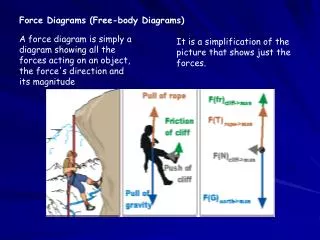
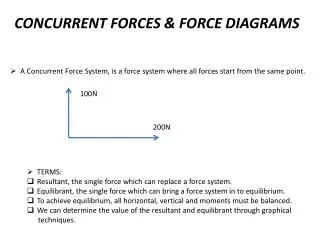
Force Diagrams • Force is a vector quantity, meaning that it has both magnitude and direction. • In complex situations (like a car crashing into a wall), force diagrams help physicists to analyze the situation.
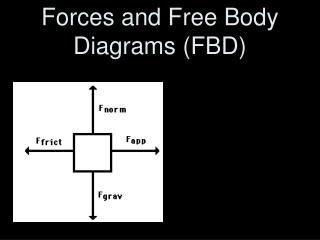
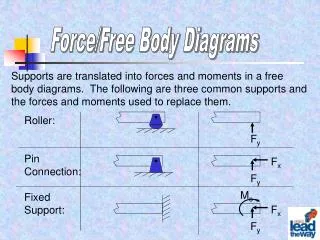
Free-Body Diagrams (FBDs) • To determine the effects of all of the forces acting on one object, a free-body diagram (FBD) is drawn. • Only the forces ACTING ON THE OBJECT are drawn, pointing in the directions in which they act.
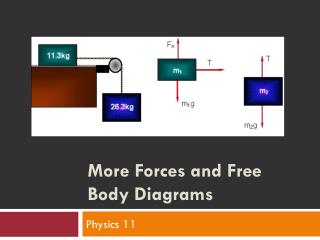
FBD Example • Consider the forces acting on the car in the tow truck below.
FBD Practice • Sketch the FBD for the following two situations: • A book lying on a flat table. • A book lying on a ramp with an incline of 15°
Wrap-Up: Did we meet our objectives? • Explain how force affects the motion of an object. • Distinguish between contact forces and field forces. • Interpret and construct free-body diagrams (FBDs)
Homework • p. 128 #2, 3, 5 and 6 • Science Fair • Notebook and Research due Wednesday • Rough draft of Procedure due Wednesday 12/5